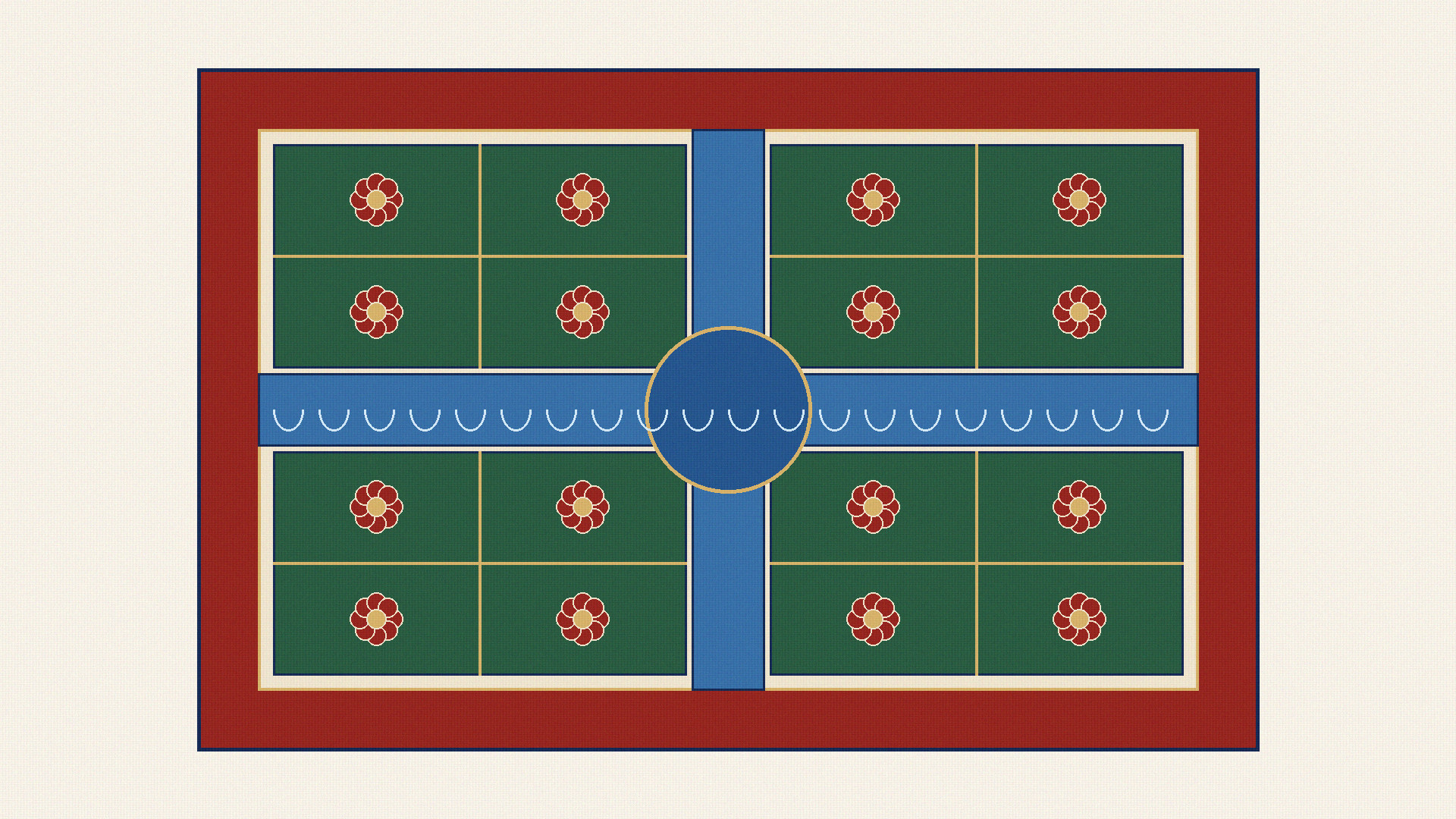
Across the arid plateau of Iran, the walled irrigated garden has for millennia stood as a sanctuary of shade, running water, and ordered blossom 12. When Persian court and regional weavers translated that architectural plan into wool and silk pile, they created one of the most celebrated genres in textile history: the Persian garden carpet (qali-ye baghi / قالی باغی) 234. Bringing an evergreen spring indoors during winter or dry summer months, these carpets map the layout of a real Persian garden directly onto the floor 24.
The Persian Garden (Chahar Bagh) Idea
In Persian architecture and landscape history, the classical formal garden is organized around the chahar bagh (چهارباغ, literally "four gardens")—a rectangular enclosure divided by intersecting axial pathways or stone water channels into four symmetrical quadrants 12.
As archaeological excavations at Pasargadae and Susa demonstrate, the quadripartite chahar bagh plan dates back to the Achaemenid period under Cyrus the Great (r. 559–530 BCE), where stone channels defined watered garden courts in front of royal pavilions 1. The tradition continued through the Sasanian era—famous in literary accounts for the legendary royal winter carpet known as the Bahar-e Kasra ("Spring of Khosrow"), though the original sixth-century Sasanian textile did not survive and its exact weaving technique remains uncertain 45—and reached monumental urban scale in Safavid Isfahan under Shah Abbas I at the end of the sixteenth century 26.
How Garden Carpets Show Channels, Beds, Trees, and Fish
To represent a three-dimensional walled garden on a flat rectangular textile, Persian carpet draughtsmen combined two perspectives at once—an architectural technique shared with Persian miniature painting 234:
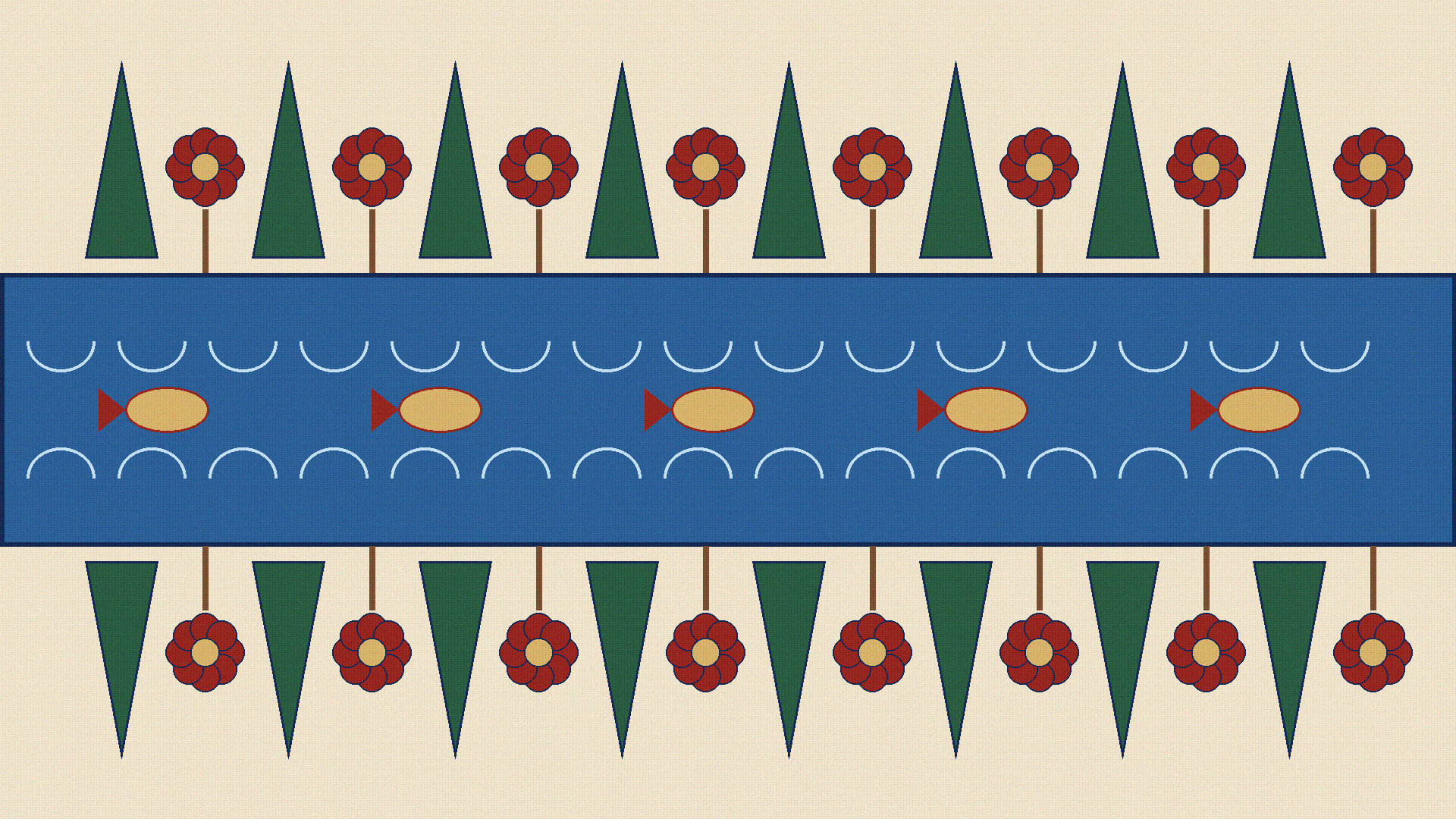
Bird’s-Eye Plan of Water Channels and Pools: A wide central watercourse runs down the vertical axis of the field, intersected at right angles by one or more cross-canals that meet at a central square, octagonal, or cruciform stone pool 347. Rippling chevron or wave lines mark the moving water 47.
Side-Profile View of Trees and Shrubs: Rather than drawing trees as flat circles from above, weavers fold the avenues of upright cypresses (sarv), plane trees (chenar), and flowering fruit trees outward from the banks of the canals so their trunks, branches, and blossoms are clearly visible in side profile 247.
Subdivided Flower Plots (Karts): Each of the four main garden quadrants is further divided by narrower feeder channels into square or rectangular sunken flower beds filled with geometric or curvilinear blossoms 347.
Fish, Waterfowl, and Birds: Inside the blue or ivory water stripes, weavers often place stylized fish, ducks, or aquatic creatures swimming among the ripples, while songbirds perch in the surrounding tree canopies 47.
Famous Historical Examples in Museums
Several surviving seventeenth- and eighteenth-century Persian garden carpets preserve the chahar bagh layout in major museum collections 3478:
The Metropolitan Museum of Art Garden Carpet (New York): The Met’s eighteenth-century northwestern Iranian Garden Carpet (Object Number 08.167.1) displays a classic central water canal intersecting horizontal channels around a central pool, flanked by formal planted parterres and architectural borders 7.
The Jaipur and Wagner Garden Carpets (Early Safavid / Kerman Group): As documented by Encyclopaedia Britannica and Safavid carpet studies, the earliest surviving knotted-pile garden carpets—dating from the late sixteenth or early seventeenth century and attributed to Kerman—include the monumental garden carpet preserved in the Maharaja Sawai Man Singh II Museum at Jaipur and the Wagner Garden Carpet in the Burrell Collection in Glasgow 48.
Later Northwestern Iranian / Kurdish Garden Carpets: Eighteenth- and early nineteenth-century garden carpets from northwestern Iran and Kurdistan translated the Safavid court layout into bolder, more geometric water channels and vibrant madder-red and indigo parterres 479.
The Kheshti (Compartment) Garden Layout
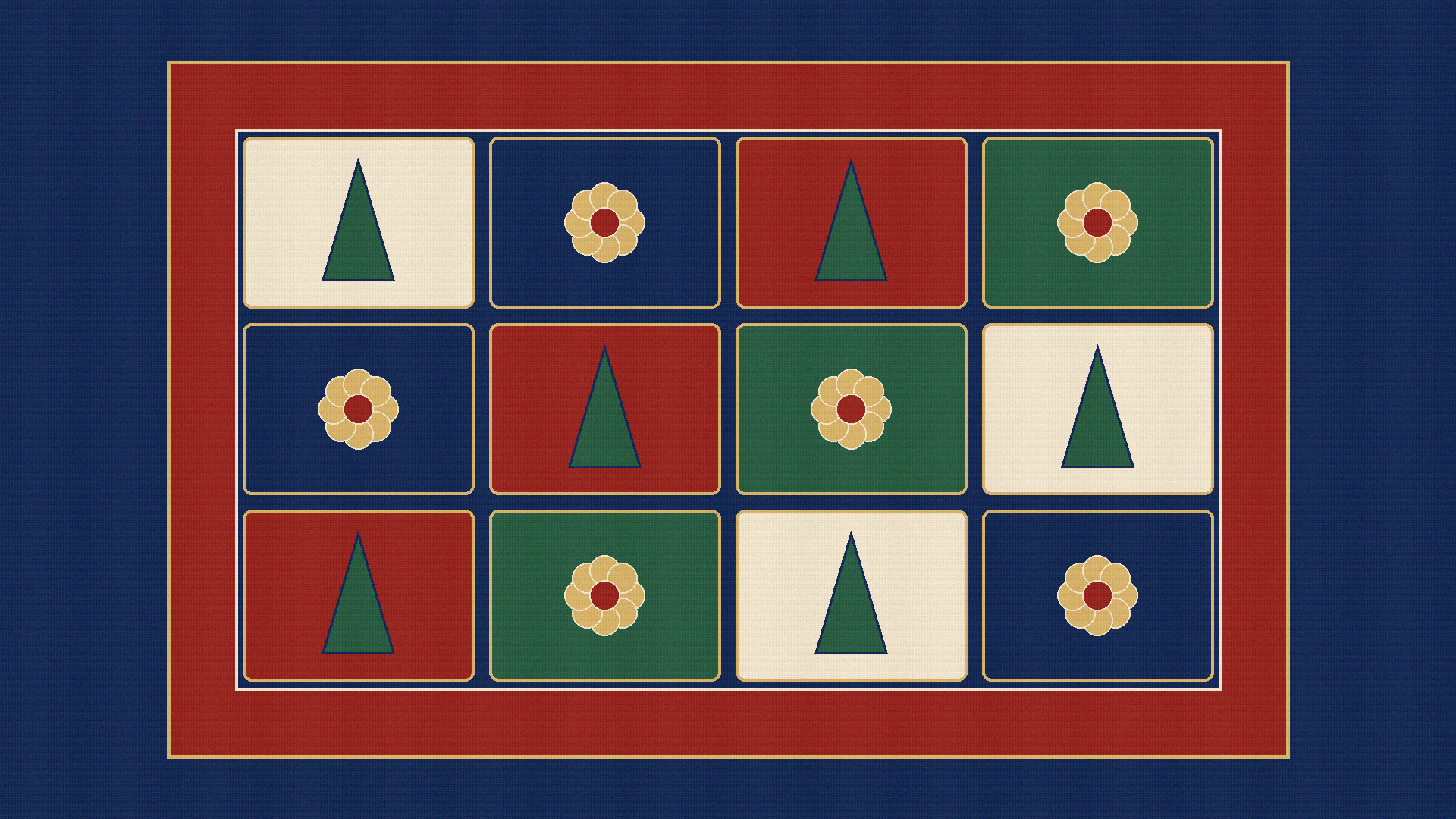
Alongside the literal map of intersecting water canals, Iranian weavers developed a closely related modular garden design known in Persian as kheshti (خشتی, "brick-shaped" or "tiled") or qab-bandi (قاببندی, "framed compartments") 3910.
Instead of long continuous water channels, a kheshti garden carpet divides the entire field into an ordered grid of square, rectangular, or polygonal tiles 310. Each individual compartment acts as a miniature garden window containing a single cypress tree, a weeping willow (bid-majnun), a flowering vase, a floral spray, or a bird 910. Historically popularized in Bakhtiari weaving centers of Chahar Mahal (where it is often called kheshti or garden-panel design) as well as in Tabriz and Qom, the compartment layout offers balanced symmetry from every side of a room 3910.
Garden Designs Today
In contemporary Iranian rug production—both hand-knotted and machine-made—both branches of the garden tradition remain highly popular with international buyers and interior designers:
Classical Chahar Bagh Recreations: Adaptations of seventeenth- and eighteenth-century canal-and-pool layouts that serve as conversational statement pieces in living rooms, libraries, and reception halls.
Tiled Kheshti (Compartment) Rugs: Grid-based botanical carpets whose repeating frames organize rich floral variety into a neat, architectural geometry ideal for modern sofas and dining tables.
Common Misconceptions
"Every floral Persian rug is technically a 'garden carpet'." While almost all floral Persian rugs evoke nature in a broad poetic sense, in strict carpet classification the term garden carpet (qali-ye baghi) refers specifically to layouts that depict architectural garden plots, water channels, pools, or kheshti botanical compartments 234.
"The Sasanian 'Spring of Khosrow' carpet survives in a museum." The sixth-century Bahar-e Kasra is known only from later medieval historical texts; the original carpet was cut up in antiquity, and its exact weave structure (flatwoven, embroidered, or pile) remains uncertain 45.
"The sideways trees in a chahar bagh carpet are drawn upside down." Laying trees flat outward from the canal banks is a deliberate Persian draughting convention so viewers walking around the carpet can read every tree in full profile rather than as a dot from above 24.
"Kheshti compartment rugs are only woven in one tribal area." While closely associated with Bakhtiari weavers, compartment designs have a documented history reaching back to Safavid court carpets (such as the Compartment Carpet at The Met) and modern urban workshops 3910.
A Short Practical Checklist: How to Read a Garden Carpet
- Distinguish Chahar Bagh vs. Kheshti: Check whether the field is crossed by continuous striped water canals meeting at a central pool (chahar bagh) or divided into uniform tiled frames (kheshti) 347.
- Look for Ripple Stripes and Fish: Inspect the axial bands for wavy water chevrons, swimming fish, or ducks that confirm a watercourse layout 47.
- Check the Four Quadrants: Trace how the main channels divide the field into four symmetrical garden sections subdivided into smaller flower beds 147.
- Match the Room Layout: Use grid-based kheshti rugs when you want multi-directional symmetry under tables, or open-view seating around a classic chahar bagh pool 37.
Frequently Asked Questions (FAQ)
1. What does "Chahar Bagh" mean in Persian?
Chahar bagh (چهارباغ) literally means "four gardens." It describes the classical Persian quadrilateral garden plan divided into four symmetrical quarters by intersecting walkways or water channels 12.
2. Why do water channels in Persian garden carpets have zigzag or chevron lines?
In classical Persian textile and miniature conventions, closely spaced zigzag, chevron, or undulating lines represent the sparkling ripples of moving water inside stone irrigation canals and central pools 47.
3. What is the difference between a Chahar Bagh rug and a Kheshti rug?
A Chahar Bagh garden rug maps an architectural garden with long intersecting water canals, a central pool, and planted flower beds 47. A Kheshti ("brick/tile") rug divides the field into a uniform grid of square or rectangular frames, each holding a single tree, flower spray, or bird 3910.
4. Where can I see authentic historical Persian garden carpets today?
Major examples are preserved in public museum collections, including The Metropolitan Museum of Art in New York (Object 08.167.1), the Burrell Collection in Glasgow (the Wagner Garden Carpet), and the City Palace Museum in Jaipur 478.
Sources
- David Stronach, "ČAHĀRBĀḠ," Encyclopaedia Iranica, Vol. IV, Fasc. 6, pp. 624–625 (1990; updated 2013; documents the Achaemenid origins at Pasargadae and Susa and the four-part symmetrical garden plan). https://www.iranicaonline.org/articles/caharbag-lit/
- Lisa Golombek, "GARDEN vi. In Persian Art," Encyclopaedia Iranica, Vol. X, Fasc. 3, pp. 310–313 (2000; updated 2016; documents the relationship between real Persian gardens, poetry, painting, and decorative arts). https://www.iranicaonline.org/articles/garden-vi/
- Annette Ittig, "CARPETS iv. Knotted-pile carpets: Designs, motifs, and patterns," Encyclopaedia Iranica, Vol. IV, Fasc. 8, pp. 845–850 (1990; updated 2017; documents garden and compartment carpet designs). https://www.iranicaonline.org/articles/carpets-iv/
- Encyclopaedia Britannica, "Garden carpet". https://www.britannica.com/art/garden-carpet
- Kawami / Vogelsang-Eastwood in "CARPETS vi. Pre-Islamic Carpets," Encyclopaedia Iranica, Vol. IV, Fasc. 8, pp. 858–861. https://www.iranicaonline.org/articles/carpets-vi/
- Roger Savory, "ČAHĀRBĀḠ-E EṢFAHĀN," Encyclopaedia Iranica, Vol. IV, Fasc. 6, pp. 625–626 (1990; documents Shah Abbas I’s Safavid Chahar Bagh avenue and stone water channels in Isfahan). https://www.iranicaonline.org/articles/caharbag-e-esfahan-the-name-of-a-broad-avenue-maximum-width-48-m-52-yards-which-was-a-key-feature-of-the-city-of-i/?generate_pdf=1
- The Metropolitan Museum of Art, New York, "Garden Carpet (Object Number 08.167.1), Attributed to Northwestern Iran, 18th century." https://www.metmuseum.org/art/collection/search/451940
- Daniel Walker, "CARPETS ix. Safavid Period," Encyclopaedia Iranica, Vol. IV, Fasc. 8, pp. 866–875 (1990; updated 2017; documents Safavid garden and vase-technique carpets). https://www.iranicaonline.org/articles/carpets-ix/
- A. Cecil Edwards, The Persian Carpet: A Survey of the Carpet-Weaving Industry of Persia, London: Gerald Duckworth & Co., 1953. https://archive.org/details/persiancarpetsur0000edwa
- The Metropolitan Museum of Art, New York, "Carpet with a Compartment Design (Object Number 1971.263), Iran, 17th century." https://www.metmuseum.org/art/collection/search/445996