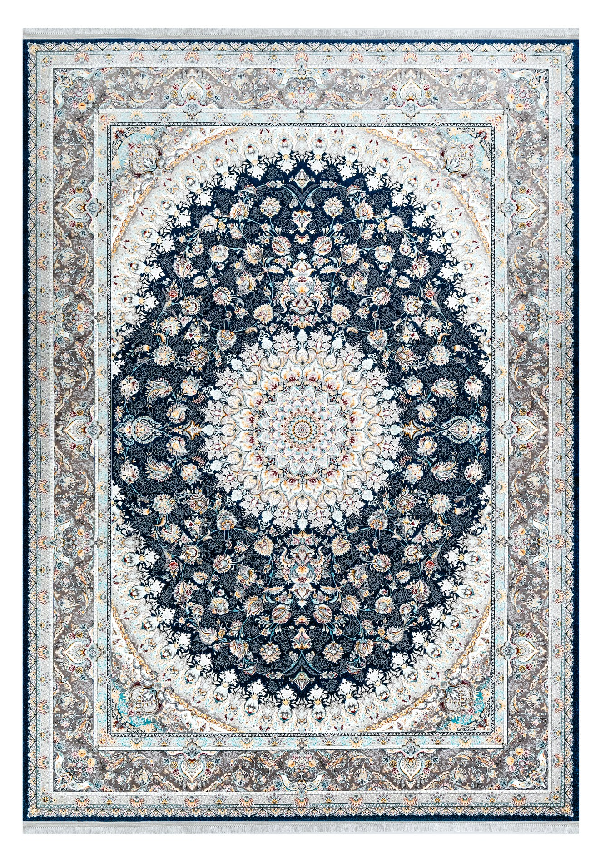
The main difference between handwoven and machine-made rugs lies in how the pile is attached to the rug's foundation. In a handwoven rug, tufts of yarn are usually knotted onto the foundation, and the free ends of the knots form the pile 1. In a machine-made rug, the pile enters the structure through a mechanical process 1.
This article explains the structure of both. Its aim is not to show that one is superior to the other, because they are different products for different needs.
How is a handwoven rug made?
Britannica describes a handwoven rug as generally the result of knotting a number of pile tufts onto a foundation structure 1. Knotted rugs are usually attributed to the country that made them, as with a Persian rug, and sometimes the name of a city or region stays attached to them, as with Kerman 1.
Not all hand-made rugs have pile. Kilim-type rugs woven by the tapestry method have a flat or slightly raised surface 1.
How is a machine-made rug made?
There is no single method for making a machine-made rug. The most important groups are these:
| Method | How it is made | Characteristics |
|---|---|---|
| Wilton | The design is created by bringing the yarn of the required colour to the surface and hiding the other yarns beneath 1. | Allows complex design and colour; loop or cut pile 2 |
| Axminster | It resembles knotted weaving, but the pile yarn is inserted and bound mechanically and is not knotted 1. | Cut pile only; wide variety of design and colour 2 |
| Velvet | Yarns are looped over wires, and the wire is withdrawn after each row 1. | Mostly single-colour; quality of the work is achieved through pile density 2 |
| Tufting | Tufts of yarn are pushed with needles into a pre-woven foundation 1. | Has a separate foundation and an adhesive or backing 2 |
In machine weaving, the pile yarn and the foundation yarns are woven at the same time and the final product is integral 2. So the phrase "machine-made rug" does not by itself tell you which method was used to make the rug.
The two methods at a glance
| Topic | Knotted handwoven rug | Machine-made rug |
|---|---|---|
| Pile attachment | Knotted to the foundation 1 | Mechanical insertion, depending on the method 1 |
| Common naming | Based on the country and region of production 1 | Based on the weaving method and technical specifications |
| Key figures in the specifications | Row count (raj) and material | Reed count, density, material and pile weight |
Which should you choose?
This choice depends on your needs and there is no definitive rule. If you are looking for a one-of-a-kind piece with regional authenticity, a handwoven rug is the natural route. If, for a project or for wholesale, you need a uniform design, a specific size and the possibility of repeat orders, a machine-made rug is more suitable.
In either case, do not judge from a collection name or a photo, and get the specifications in writing.
What to ask before buying a machine-made rug
- What method was this rug woven with?
- What is the pile yarn material?
- What are the reed count, density, pile height and pile weight?
- Which code, colour and size do these specifications apply to?
Summary
A handwoven rug is made by knotting the pile onto the foundation, and a machine-made rug by various mechanical methods. Knowing the weaving method helps you compare two rugs properly. To see designs, visit the FARSHINEH catalogue section, and for the specifications of each design, ask our specialists.
Frequently asked questions
Do machine-made rugs have knots?
In machine methods such as Axminster, the pile yarn is inserted and bound and is not knotted 1. For this reason, the word "knot" in the specifications of a machine-made rug does not have the precise meaning it has for a handwoven rug.
Can a machine-made rug have a complex design?
Yes. Wilton weaving allows complex design and colour, and Axminster offers a wide variety of design and colour 2.
What is the difference between a rug and fitted carpet?
In present-day usage, fitted carpet is usually fixed to the floor and covers the whole surface, whereas a rug is not fixed and rarely covers the whole floor 1.
Sources
- Ellis, Peter. Floor covering. Encyclopaedia Britannica, 2022. https://www.britannica.com/technology/floor-covering
- The Carpet and Rug Institute. The Carpet Primer. 2017. https://carpet-rug.org/wp-content/uploads/2020/02/The-Carpet-Primer.pdf