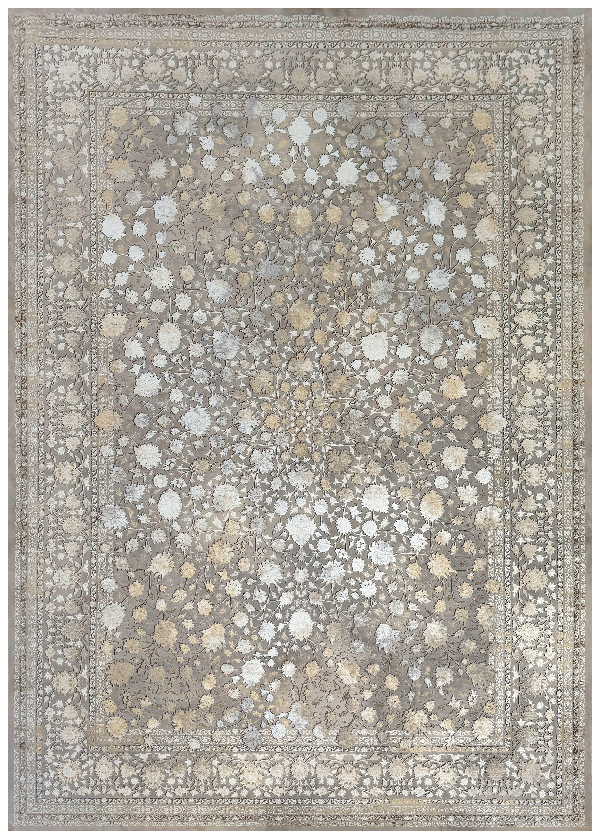
The machine-made rug was not invented all at once. The industry is the result of several centuries of gradual change in weaving. Organised workshops came first, then the design mechanism was automated, and finally motor power replaced hand power.
Workshops before the machine
Carpet weaving was established in Europe long before the machine. English carpet weavers received official charters at Wilton and Axminster in 1701, and around 1740 weavers from France were brought to Wilton 1. The names of these two towns still survive in two important weaving methods.
Jacquard: when design became automatic
The Industrial Revolution transformed weaving. In the eighteenth century, machines were built that revolutionised cloth production. The Jacquard mechanism controlled the warp yarns with punched cards and gradually replaced the complex harness of hand looms for producing designs 1.
The first power looms
| Year | Event 1 |
|---|---|
| 1830s | Development of the tapestry method for printing designs in Edinburgh |
| 1839 | First use of the power loom in carpet making |
| 1839 | Registration of the chenille Axminster method by James Templeton in Glasgow |
| 1841 | Appearance of the power loom in America |
| 1876 | Invention of the Axminster loom, which greatly widened the range of design and colour |
Looms also became wider. Common widths of 46 to 91 centimetres grew to four to six metres, a change that reduced the cost of weaving and enlarged the seamless surface 1.
Tufting and synthetic fibres
After the Second World War, needle tufting spread 1. In this method, the pile yarn is pushed into a pre-woven foundation. The Carpet and Rug Institute says that the broadloom tufting machine and synthetic fibres took the American carpet industry from low-volume luxury goods to mass production in the early 1950s 2.
Machine-made rugs in Iran
No official source available to us has confirmed the starting point of this industry in Iran. Reports from people working in the industry attribute the start of production to the 1350s of the Solar Hijri calendar, in Kashan. For this reason we give this date with caution.
To learn about the production regions, read the article "Machine-Made Rug Production Centres in Iran".
Summary
The machine-made rug is the result of several successive steps: specialised workshops, automated Jacquard design, motor power, and then tufting and synthetic fibres. This history shows that "machine-made rug" is not a single technology. To see present-day examples, visit the FARSHINEH catalogue section.
Frequently asked questions
When was the first machine-made rug woven?
Britannica places the first use of the power loom in carpet making in 1839 1.
What does Jacquard do in rug making?
It controls the warp yarns with punched cards to create the design 1.
Are Wilton and Axminster the names of towns?
Yes. Both are names of towns in England whose carpet weavers received official charters in 1701 1.
Sources
- Ellis, Peter. Floor covering. Encyclopaedia Britannica, 2022. https://www.britannica.com/technology/floor-covering
- The Carpet and Rug Institute. The Carpet Primer. 2017. https://carpet-rug.org/wp-content/uploads/2020/02/The-Carpet-Primer.pdf