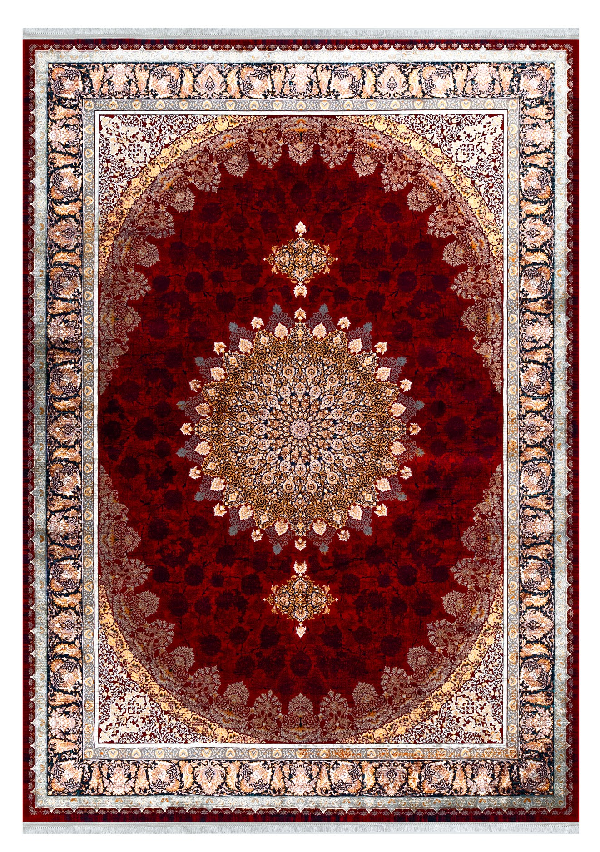
The medallion (toranj) is one of the best-known elements of Persian rug design. If you have seen a rug with a large motif in the centre and four motifs in the corners, you already know the medallion-and-corner layout (lachak-toranj). In this article we look at how this structure works.
What is a medallion?
Encyclopaedia Iranica describes the medallion as a usually curved motif that often sits at the centre of a rug's field. Its common forms are the pointed oval, the circle, the shield and the lozenge, and its edges are mostly lobed or stepped 1.
The parts of a medallion design
| Part | Function |
|---|---|
| Medallion (toranj) | The main motif at the centre; the design is balanced around it in length and width 1 |
| Corner spandrel (lachak) | Four corner motifs which, in the Ardabil Carpet, are a quarter of a composition similar to but simpler than the centre 2 |
| Field | The main ground around the medallion |
| Border | The bands running around the rug; four parallel bands in the Ardabil Carpet 2 |
In Iranica, the medallion design falls into the category of centralised designs. In a multiple-medallion design, rows of medallions, connected or overlapping, fill the field 1.
A historic example: the Ardabil Carpet
The Ardabil Carpet in the Victoria and Albert Museum in London is, according to the museum itself, the world's oldest dated carpet 2.
- Date: the inscription at the edge of the carpet shows the year 946 in the Islamic lunar (Hijri) calendar, equivalent to 1539 to 1540 CE 2.
- Structure: a large rectangular field with a yellow medallion at the centre, surrounded by a ring of pointed ovals, with a lamp hanging from each of its two sides 2.
- Fineness: about 5300 knots per 10 cm by 10 cm square 2.
- Colour: ten colours from natural materials such as pomegranate skin and indigo 2.
Why are the two lamps different sizes?
The museum reports two opinions. One is that the aim was an optical illusion, although there is no other evidence of such perspective in Iran in the 1530s. The other is that this flaw was deliberate, to show that perfection belongs to God alone 2. Neither is certain.
The medallion in machine-made rugs
The medallion-and-corner layout has also made its way into machine-made rugs. To assess a medallion design in a machine-made rug, look at the following:
- Do the medallion's curves look smooth and free of stepping at this rug's reed count?
- Has the design been drawn for the size you are ordering? The proportion of medallion to field changes as the size changes.
- Does a medallion suit the layout of the space? Furniture should not cover the centre of the design.
These points are our practical advice and are not definitive rules.
Summary
The medallion is the central motif that organises the entire design and, together with the corner spandrels and border, creates a balanced structure. To see medallion designs, visit the FARSHINEH catalogue section.
Frequently asked questions
What is the difference between a medallion and a corner spandrel?
The medallion is the central motif and the corner spandrel is the corner motif 12.
What is the symbolic meaning of the medallion?
The sources we read for this article do not give a definitive symbolic meaning for the medallion. We have therefore refrained from repeating common interpretations.
Where was the Ardabil Carpet woven?
According to the museum, in the city of Ardabil in north-west Iran 2.
Sources
- Carpets iv. Knotted-pile carpets: Designs, motifs, and patterns. Encyclopaedia Iranica. https://www.iranicaonline.org/articles/carpets-iv/
- Victoria and Albert Museum. The Ardabil Carpet. https://www.vam.ac.uk/articles/the-ardabil-carpet