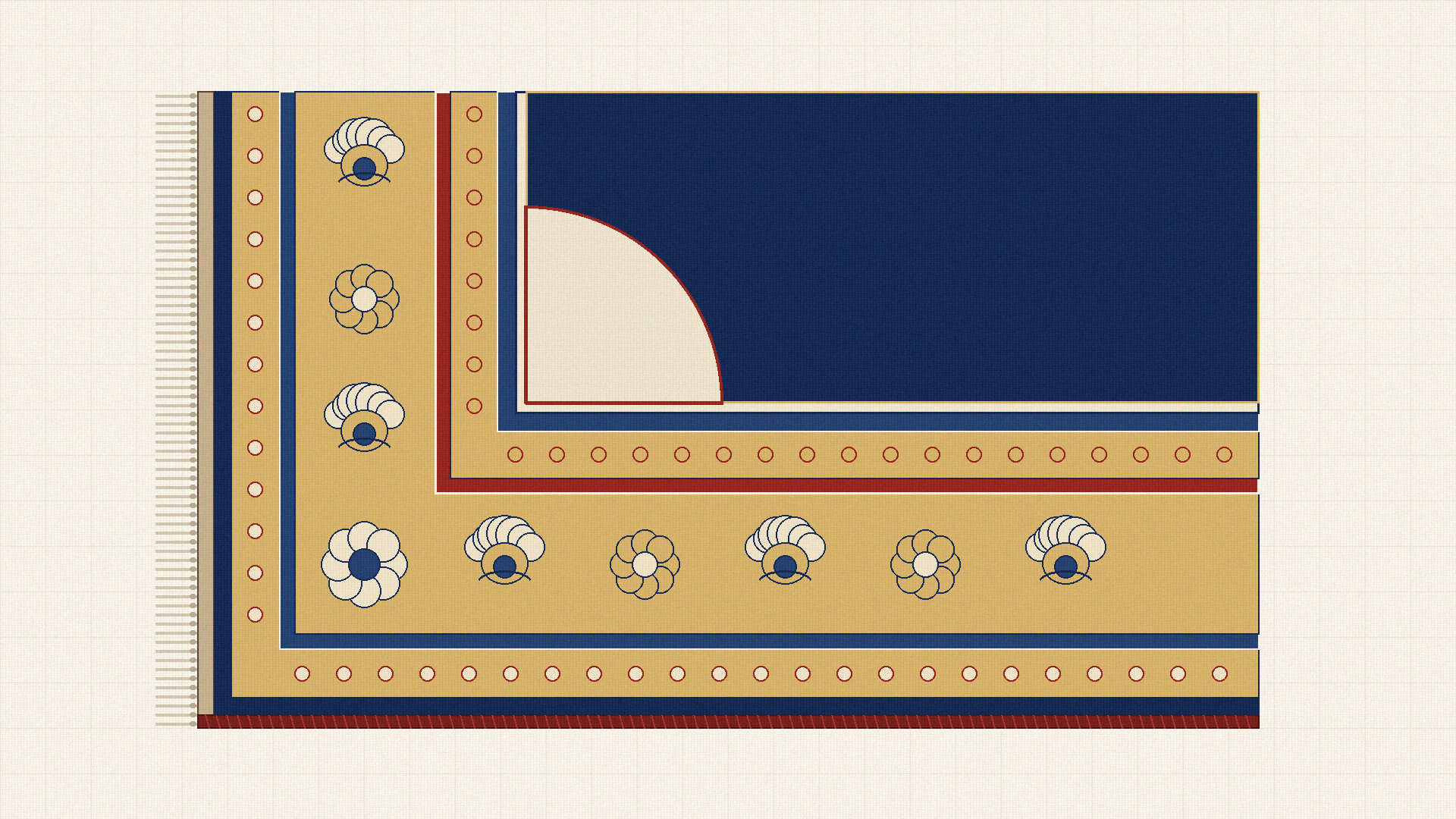
When most buyers first look at a Persian rug, their eyes go straight to the centre of the field. Yet in Iranian carpet design, the border system—known in Persian as the hashiyeh (حاشیه)—is just as important as the field it surrounds 12. Far more than a decorative strip around the edges, a traditional Persian border acts as an architectural frame. It holds the inner pattern together, guides the eye around the room, and carries its own distinct vocabulary of vines, blossoms, and geometric bands 123.
What a Border Does in a Persian Rug
In classical and regional Persian weaving, the border performs three practical and visual roles at the same time 123:
Visual Containment: Whether a rug has a central medallion (toranj) or a continuous all-over repeat (afshan or mahi), the field pattern often looks as though it could continue infinitely outward 12. The border creates a clear boundary that brings that movement to rest before the physical edge of the textile 12.
Transition to the Floor: In a furnished room, the border bridges the richly patterned field and the plain surface of timber, stone, or tile flooring. Its layered bands step the viewer’s eye gradually from the room into the heart of the carpet 23.
Structural and Stylistic Identity: In historic workshop and village traditions, weavers frequently paired a specific type of main border and guard stripe with a particular field layout, making the border an important clue when identifying a rug’s design family and regional heritage 123.
Anatomy of the Persian Rug Border (with Persian Names)
Rarely does a Persian rug have only a single border band. Instead, most traditional carpets use a multi-band border system made up of a wide central band flanked on both sides by narrower secondary bands and thin framing stripes 123. Reading from the main band outward and inward, the standard parts are:
1. Main Border (Hashiyeh-ye Bozorg / حاشیه بزرگ or Hashiyeh-ye Asli / حاشیه اصلی)
The widest and most visually dominant continuous band running around all four sides of the rug 12. In Iranian workshop terminology, it is also sometimes called the miyan-hashiyeh (میانحاشیه, "middle border") because it sits between the inner and outer secondary borders 23. The main border carries the primary border pattern, such as alternating palmettes and rosettes or a bold geometric vine 12.
2. Minor or Secondary Borders (Hashiyeh-ye Kuchak / حاشیه کوچک)
Two narrower patterned bands positioned immediately inside and outside the main border 12. By position, weavers distinguish the inner minor border (hashiyeh-ye dakheli / حاشیه داخلی), which faces the field, from the outer minor border (hashiyeh-ye khareji / حاشیه خارجی), which faces the outer edge 23. In some workshop regions, a narrow floral secondary band is also called a kalleh-geli or abhar band, although exact local workshop nicknames vary from city to city and their historical standardization remains uncertain 13.
3. Guard Stripes (Zanjireh / زنجیره or abhar / ابهر)
Very narrow framing lines—often formed by simple repeating dots, S-hooks, Barber-pole diagonal stripes, or tiny reciprocal triangles—that separate the main border from the minor borders and mark the transition into the field 12.
4. Reciprocal Inner Guard (Madakhel / مداخل)
Where the innermost border meets the field (matn / متن), many Persian rugs feature a reciprocal crenellated or trefoil line known as madakhel ("interlocking" or "entering") 23. Light and dark battlements alternate inward and outward, locking the border and field together visually 2.
5. Outer Edges: Selvedge (Shirazeh / شیرازه), Kilim End (Gilim-baf / گلیمباف), and Fringe (Risheh / ریشه)
Outside the outermost border band lie the structural edges of the rug 14. Along the two long sides runs the reinforced flat edge or selvedge (shirazeh) 14. At the two short ends, the pile stops at a narrow flatwoven band (gilim-baf) before the warp threads emerge as fringe (risheh) 14. These are structural finishes rather than painted or drawn border bands, and fringe belongs on the short ends rather than the long sides 14.
Common Persian Border Motifs
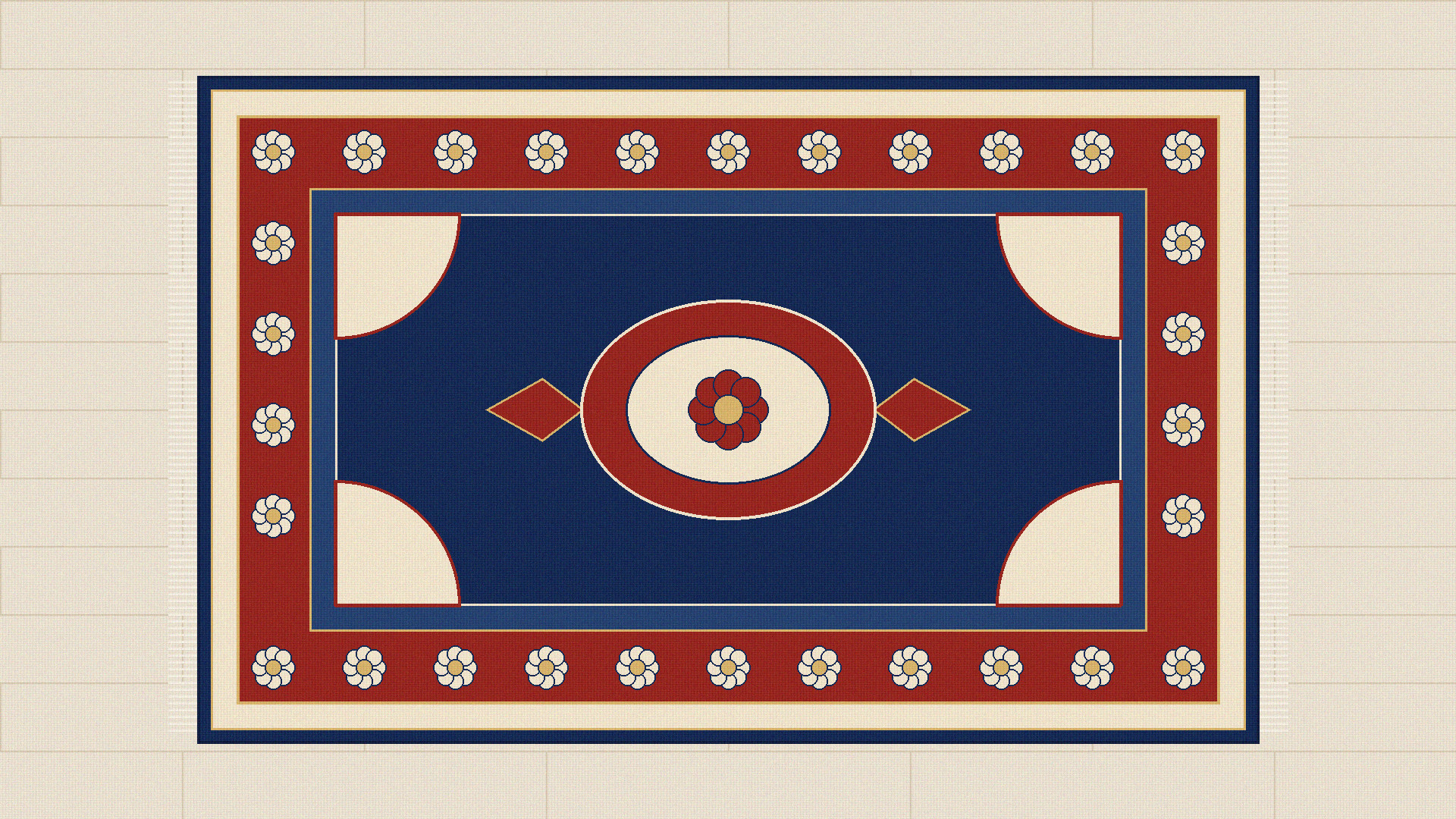
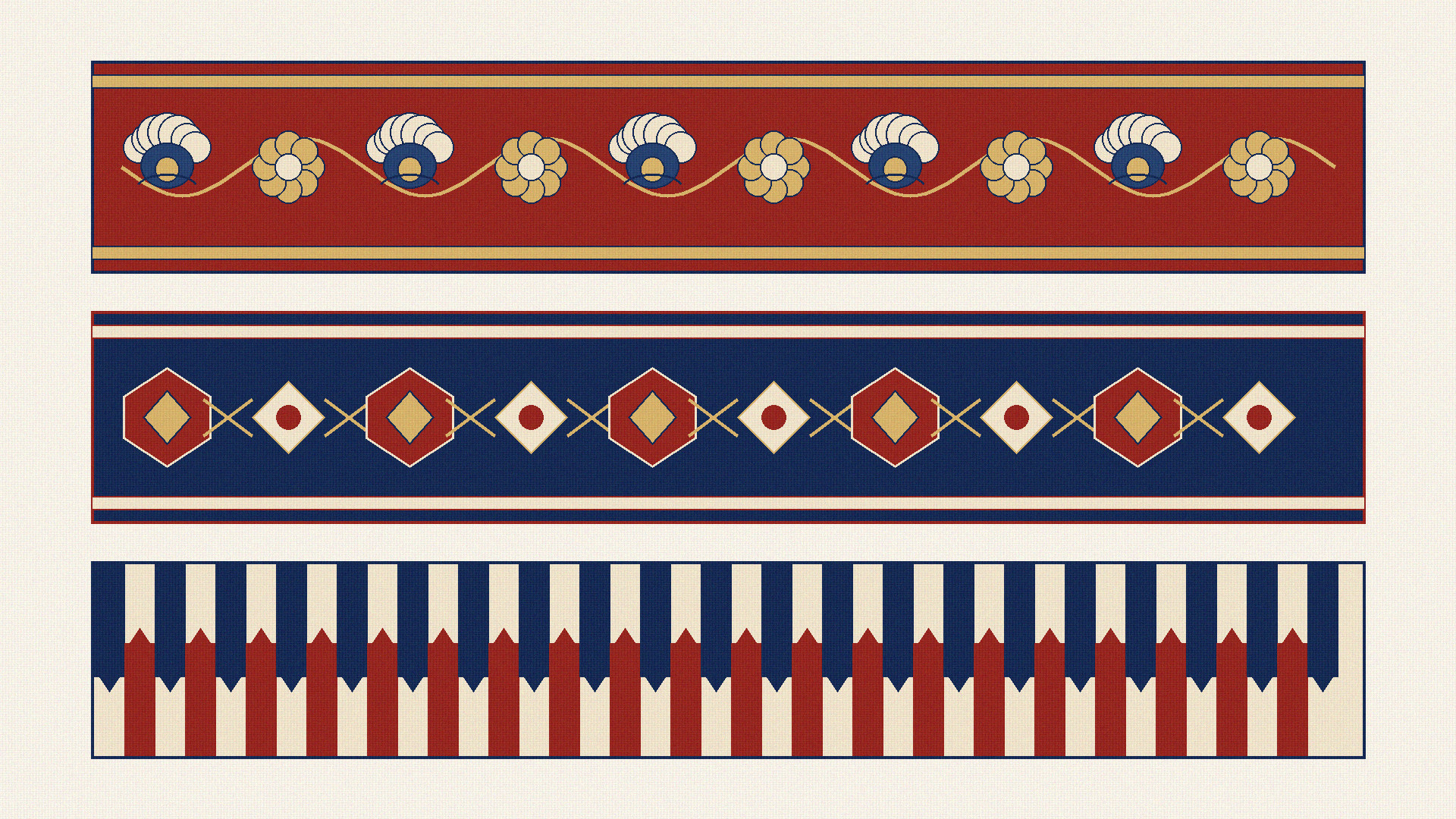
While field designs vary widely, most Persian main and minor borders draw from a well-established repertoire of repeating motifs 1235:
Shah Abbasi Palmette and Vine Border: Large fan-shaped lotus palmettes alternate with smaller round rosettes along undulating eslimi (arabesque) and khatai (floral) stems 12. This is the classic courtly border of Safavid and modern urban carpets 25.
Herati or "Turtle" Border (Samovari / سماوری or sang-poshti / سنگپشتی): An angular or curvilinear vine border in which stylized palmettes flanked by split leaves resemble small turtles or samovars linked by undulating stems 123. It is widely paired with all-over Herati (Mahi) fields 23.
Cartouche and Inscription Borders (Katibeh / کتیبه): Alternating oblong panels (cartouches) and smaller lobed medallions framing calligraphy, poetic verses, or floral sprays—famously seen on sixteenth-century Safavid carpets such as the Ardabil Carpet at the Victoria and Albert Museum and the Cartouche Border Fragment at The Metropolitan Museum of Art 567.
Floral Meander and Rosette Guard Bands: A continuous waving stem carrying small single blossoms or buds along the inner and outer minor borders 12.
Reciprocal Trefoil (Madakhel) and Stepped Polygons: Geometric interlocking battlements, stars, and hooked vines favored in village and nomadic weavings 12.
How Border and Field Work Together: Corners, Proportion, and Colour
Experienced buyers and designers read the relationship between the border and the field across three practical criteria 123:
1. Corner Resolution
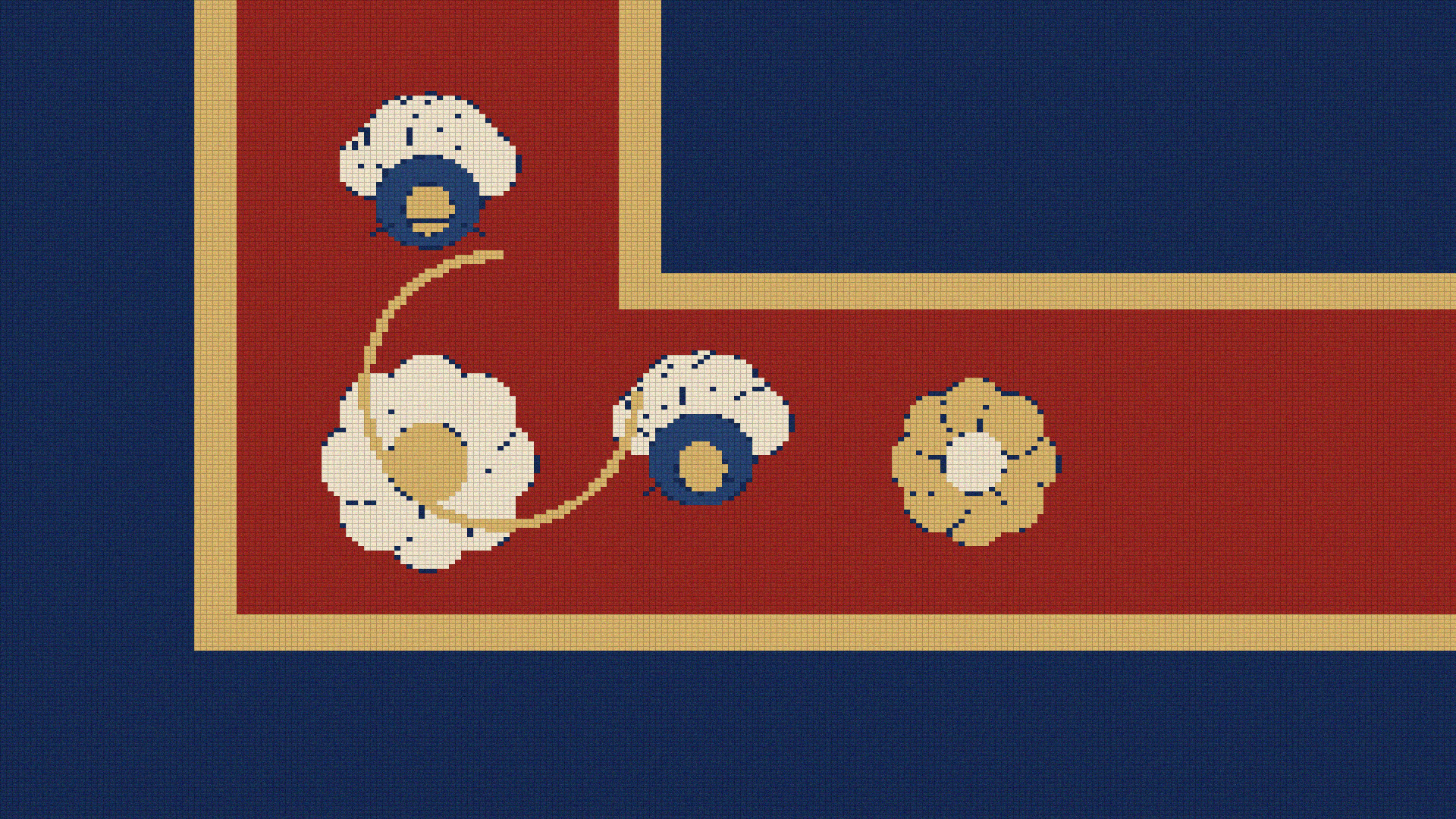
Because a border runs both lengthwise and crosswise, turning the ninety-degree corner is one of the hardest tasks in carpet design 123. In carefully drafted urban carpets (where the pattern is plotted in advance on point paper, or tarrahi-ye naqsheh), a diagonal palmette or arabesque flourish is placed precisely in the corner so the horizontal and vertical vine repeats meet seamlessly 13. In many village or nomadic rugs woven without a paper cartoon, the weaver may finish the lengthwise border motif and start the crosswise border independently, creating an unmitred or truncated corner joint 13.
2. Proportion and Visual Weight
In a balanced Persian carpet, the total width of the border system typically occupies roughly one-sixth to one-quarter of the rug’s overall width, though exact ratios vary by rug size and regional style 23. Narrow runners often use slightly slimmer borders so the central field is not crowded, while large room-size carpets can support five, seven, or more concentric border bands 23.
3. Colour Counterpoint
Designers almost always give the main border a ground colour that contrasts with the main field 23. For example, a rug with a deep navy (sormeh-i) field will commonly feature a crimson or madder-red (laki) main border, while a crimson field is frequently framed by a navy or warm ivory (kerm) main border 23. The minor borders then echo secondary colours from the central medallion or corner spandrels (lachak) to tie the palette together 23.
Regional Examples Across Iran
Although border motifs travel between regions, several Iranian weaving centres have well-documented border preferences 123:
Kashan and Isfahan: Known for finely drawn curvilinear Shah Abbasi palmette borders flanked by delicate floral minor borders and cloud-band or arabesque vine scrolls in contrasting crimson, navy, and ivory 235.
Tabriz and Northwest Iran: Frequently uses either classical Shah Abbasi borders, cartouche (katibeh) panels, or crisp angular-curvilinear samovari ("turtle") borders around Herati (Mahi) fields 123.
Kerman: Historical and twentieth-century Kerman carpets sometimes soften or open the border frame with overflowing floral sprays and multiple narrow floral bands 23.
Kurdish, Bakhtiari, and Village Traditions: Often favour bold geometric rosette borders, angular vine meanders, and strong reciprocal madakhel guard stripes 123.
Common Misconceptions
"More border bands always mean a better rug." The number of border bands reflects the regional style and overall size of the rug, not its material quality or durability 123.
"Every border motif has a fixed secret meaning." While cartouches occasionally hold readable Persian poetry, claims that every guard stripe represents a sacred river, city wall, or protective talisman are modern poetic interpretations rather than documented historical facts, and remain uncertain 125.
"Corner spandrels (lachak) are part of the border." The four lachak ornaments sit inside the corners of the field, enclosed within the innermost border band 12.
"An unmitred corner is always a manufacturing defect." In traditional village and nomadic weaving, unmitred corners are a documented feature of spontaneous loom weaving rather than an error 13.
A Short Practical Checklist: How to Read a Rug Border
- Count the Bands: Locate the wide main border first, then check whether the inner and outer minor borders and guard stripes match in number and width on all four sides 12.
- Inspect All Four Corners: Check whether the main border motif turns the ninety-degree corner symmetrically with a dedicated corner palmette or rosette 123.
- Check Ground-Colour Contrast: Observe how the main border ground colour contrasts with the field while repeating accent tones from the medallion or spandrels 23.
- Verify Straight Outer Edges: Look along the long sides (shirazeh) and short ends to ensure the outer guard stripe runs straight and parallel to the edge 14.
Borders in Machine-Made Rugs
In contemporary Iranian machine-made rugs, digital point-paper drafting allows designers to plan the entire border system before weaving begins. Because every row is mapped in advance, machine-made Persian rugs typically display clean four-way corner symmetry, where the corner palmettes in the main and minor borders align evenly at all four corners. Buyers can choose between traditional multi-band Shah Abbasi and cartouche borders for formal rooms, or lighter, simplified border frames for modern interiors.
Frequently Asked Questions (FAQ)
1. What is the Persian word for a rug border?
The general Persian term for a rug border is hashiyeh (حاشیه). The wide central band is called hashiyeh-ye bozorg (main border), while the narrower flanking bands are called hashiyeh-ye kuchak (minor borders) 12.
2. What is the difference between a minor border and a guard stripe?
A minor border (hashiyeh-ye kuchak) is a distinct secondary band large enough to hold a repeating floral vine or geometric pattern. A guard stripe (zanjireh) is a much thinner framing line—often just a narrow ribbon of dots, stripes, or reciprocal triangles—that separates two border bands 12.
3. Why do the main border and the field usually have different background colours?
Contrasting ground colours—such as a crimson border around a navy field—create a clear visual frame so the field pattern does not bleed into the edges of the rug 23.
4. Are fringe and selvedge considered part of the rug border?
In strict rug anatomy, the border (hashiyeh) refers to the woven patterned bands inside the pile area, whereas the selvedge (shirazeh) on the long sides and the kilim end and fringe (risheh) on the short ends are the structural edge finishes of the textile 14.
Sources
- Annette Ittig, "CARPETS iv. Knotted-pile carpets: Designs, motifs, and patterns," Encyclopaedia Iranica, Vol. IV, Fasc. 8, pp. 845–850 (1990; updated 2017). https://www.iranicaonline.org/articles/carpets-iv/
- Peter F. Stone, Oriental Rugs: An Illustrated Lexicon of Motifs, Materials, and Origins, Tuttle Publishing, 2013 (entries on "Border," "Guard stripe," "Main border," "Medakhel," and "Turtle border"). https://search.worldcat.org/title/828416696
- A. Cecil Edwards, The Persian Carpet: A Survey of the Carpet-Weaving Industry of Persia, London: Gerald Duckworth & Co., 1953. https://archive.org/details/persiancarpetsur0000edwa
- Annette Ittig, "CARPETS iii. Knotted-pile carpets: Techniques and structures," Encyclopaedia Iranica, Vol. IV, Fasc. 8, pp. 843–845 (1990; updated 2017). https://www.iranicaonline.org/articles/carpets-iii/
- Daniel Walker, "CARPETS ix. Safavid Period," Encyclopaedia Iranica, Vol. IV, Fasc. 8, pp. 866–875 (1990; updated 2017). https://www.iranicaonline.org/articles/carpets-ix/
- The Metropolitan Museum of Art, New York, "Fragment of a Carpet with Cartouche Border (Object Number 36.133), Attributed to Iran, second half 16th century." https://www.metmuseum.org/art/collection/search/452186
- Victoria and Albert Museum, London, "The Ardabil Carpet (Museum No. 272-1893), Iran, 1539–1540." https://www.vam.ac.uk/articles/the-ardabil-carpet