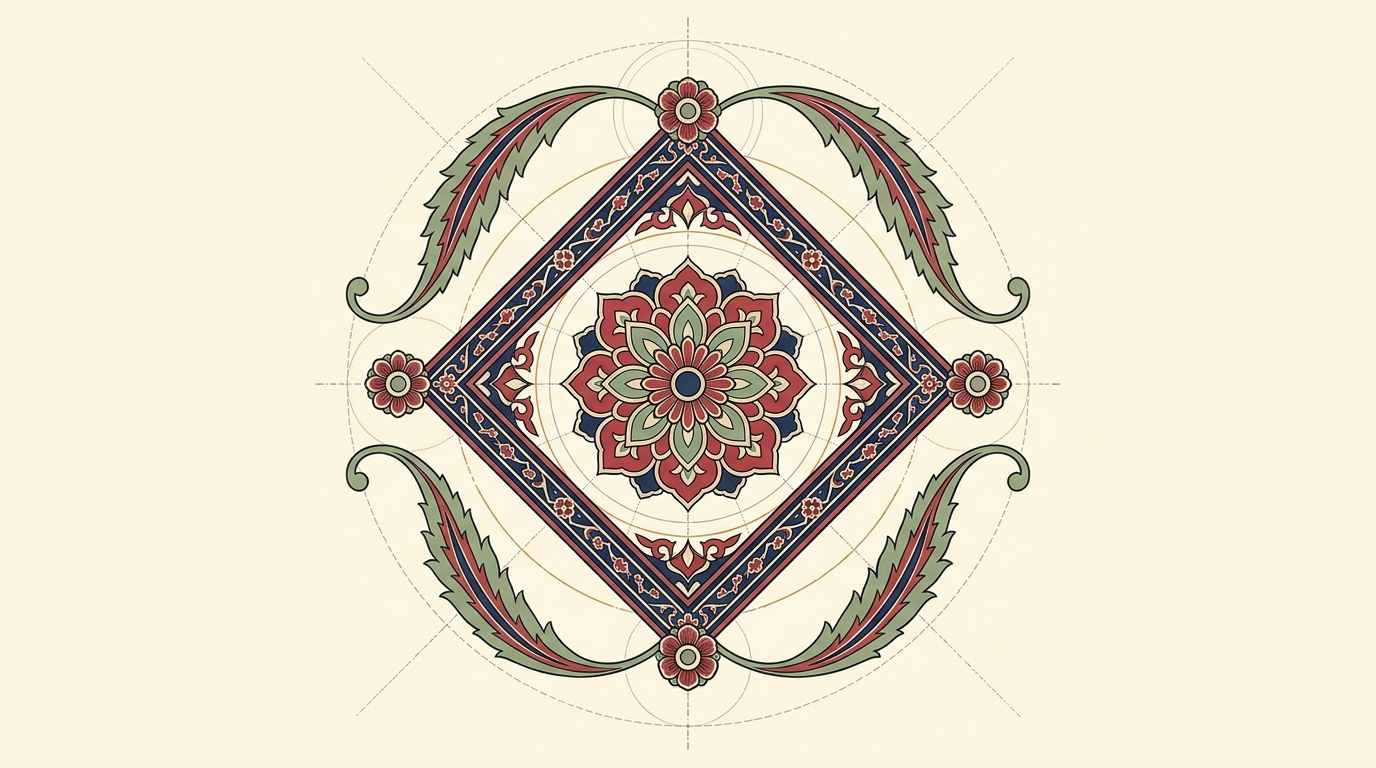
The Herati pattern is one of the most widely woven designs in Persian rugs. In Iran it is usually called mahi, which means "fish" 1. It is a small unit that repeats across the field, so it works on runners, room-size rugs and large carpets alike 12. This article explains how the unit is built, where the name comes from and which layouts buyers usually see.
The parts of one Herati unit
Encyclopaedia Iranica describes the unit as a rosette framed in a rhombus, with palmettes at the corners and four sickle-shaped leaves around the whole 1. In simple terms:
- Centre flower: a small rosette in the middle of the unit.
- Diamond frame: thin stems that make a diamond around the flower.
- Corner flowers: small palmettes or buds at the points of the diamond, which join one unit to the next.
- Four curved leaves: long, serrated leaves around the diamond.
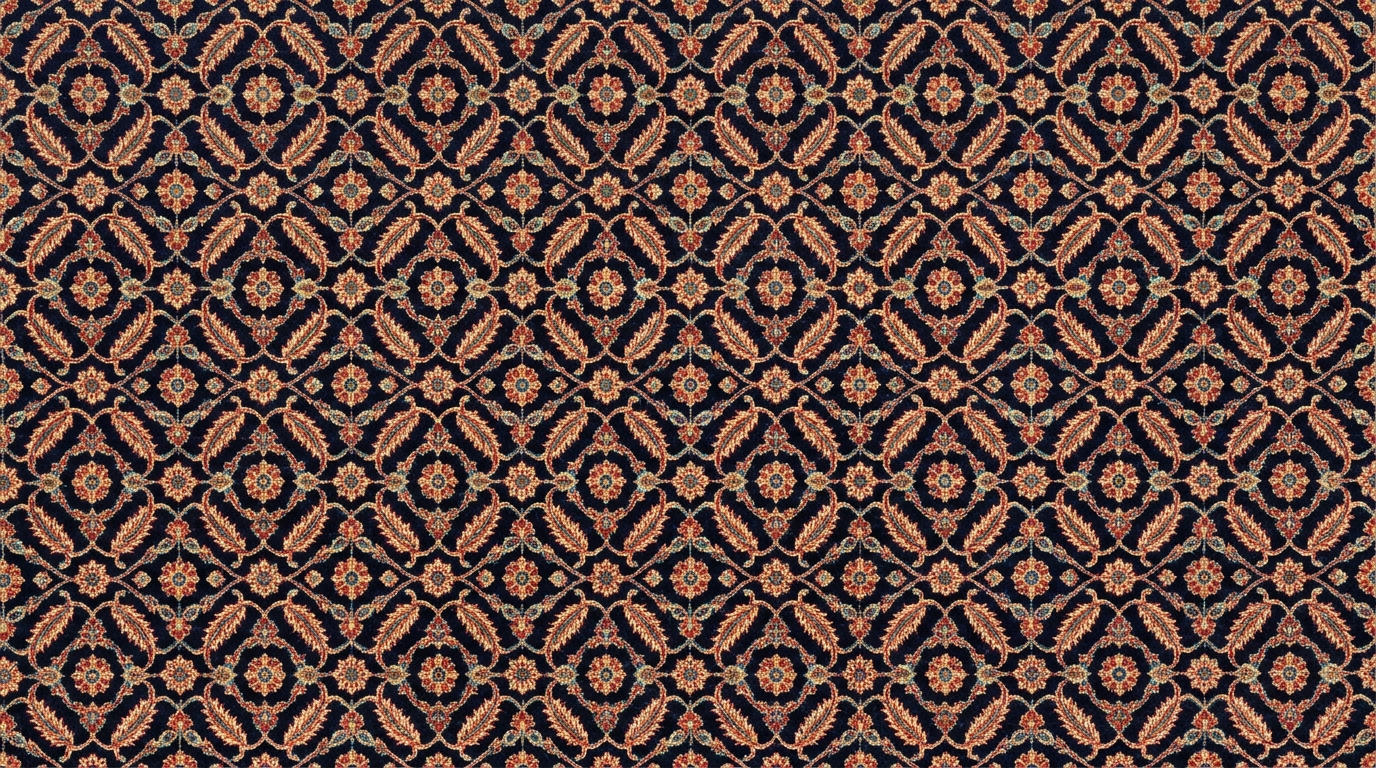
When the unit repeats, the diamonds join into a diagonal lattice across the field 13.
Why "Herati" and why "mahi"?
The name Herati means "from Herat". Iranica notes that the pattern is named after the city where it was formerly thought to have been developed 1. So the link with Herat is a traditional name, not a proven origin.
The Persian name mahi comes from the four curved leaves, which look like small fish 1. Whether the first designers meant fish or leaves is not recorded. We treat it as uncertain.
Where it is woven
The pattern is woven throughout Iran with local variations, and it became a fixed part of the rug repertoire in the Qajar period 1. A. Cecil Edwards' survey of Persian weaving shows Herati fields in many regions, including Khorasan, Kurdistan (Bijar, Senneh) and the Farahan–Malayer area 2. Some regions draw the unit large and open; others make it very small and dense. In the trade the very small version is often called riz-mahi, "fine fish" 3.
Common layouts
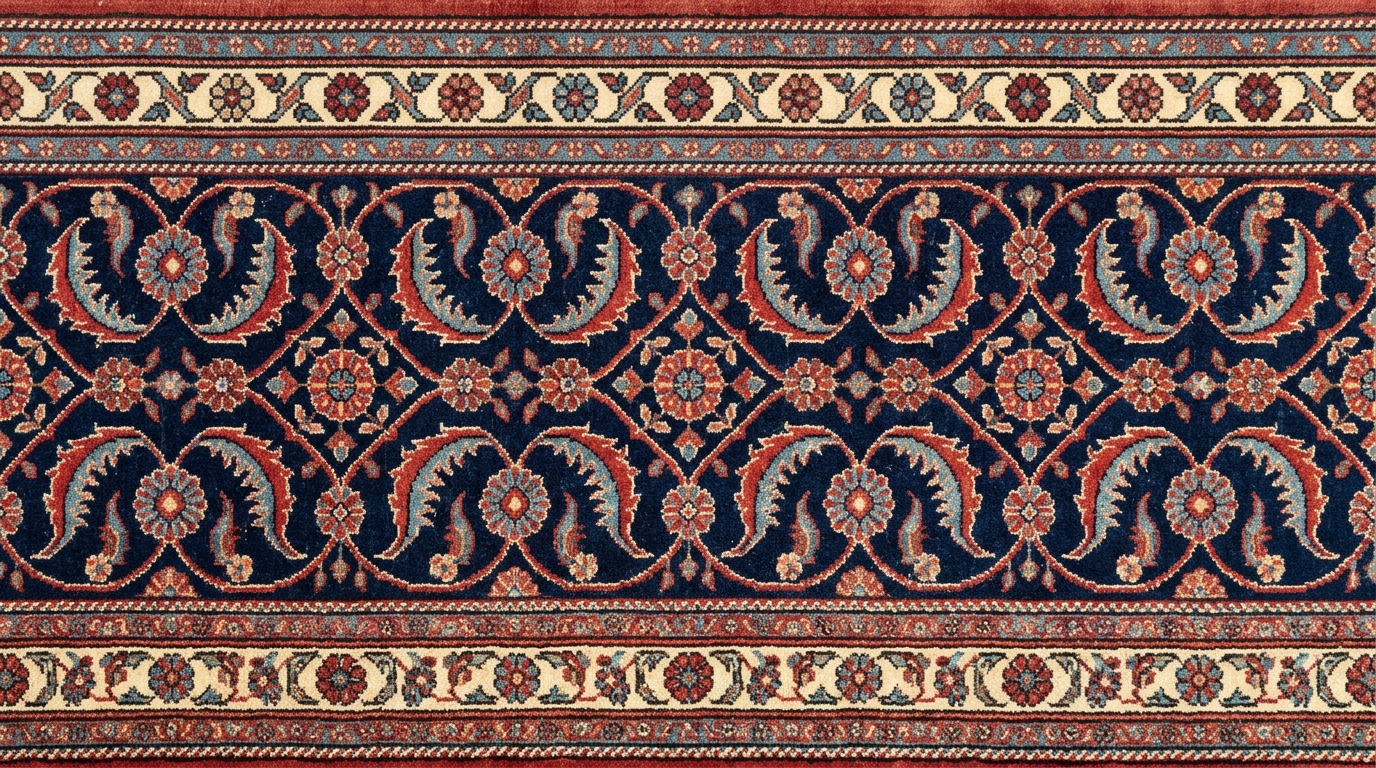
- All-over (sar-a-sar mahi): the unit repeats over the whole field with no medallion. It looks balanced from every side, so it is easy to place when furniture is off-centre.
- Medallion on a Herati field (lachak-toranj mahi): a central medallion and corner pieces sit on a Herati background. It works best when the medallion can be seen in the centre of the room.
- Compartment designs: the field is divided into panels, some of which hold Herati units 1.
Choosing a Herati rug
- Name both the motif and the layout. "Mahi" alone is not enough; say all-over or medallion.
- Check the scale. A small, dense mahi needs a fine weave so that the curved leaves stay clear. Look at a close photo before you order.
- Check runners and round rugs separately. A repeat unit cannot simply be stretched; ask for the design drawn for that size.
- Think about traffic. A busy, even pattern hides dust and footprints better than a plain ground.
These points are our practical advice.
Frequently asked questions
Why is the same pattern called Herati and mahi?
Herati is the name used in museums and the international trade; mahi ("fish") is the workshop name in Iran 1.
Are the four curved shapes fish or leaves?
Rug literature describes them as sickle-shaped leaves; the fish name comes from how they look 1. The original intention is not recorded.
What is riz-mahi?
It is a very small, dense version of the Herati unit 3.
Which is easier to place, all-over or medallion?
All-over is more flexible. A medallion rug works best when the medallion can sit in the centre of the seating or dining area.
Sources
- Ittig, Annette. CARPETS iv. Knotted-pile carpets: designs, motifs and patterns. Encyclopaedia Iranica. https://www.iranicaonline.org/articles/carpets-iv/
- Edwards, A. Cecil. The Persian Carpet. London: Duckworth, 1953. https://archive.org/details/persiancarpetsur0000edwa
- Stone, Peter F. Oriental Rugs: An Illustrated Lexicon of Motifs, Materials, and Origins. Tuttle Publishing, 2013. https://search.worldcat.org/title/828416696