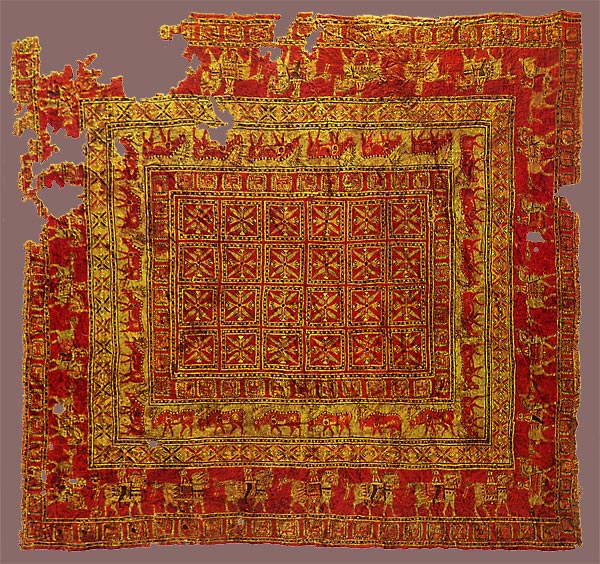
The Pazyryk carpet is the oldest well-preserved pile carpet recovered through excavation 1. Its name is heard often, but it also comes with claims that scholarly sources do not confirm. In this article we separate what is documented from what is open to debate.
What is documented
- Place of discovery: Tomb no. 5 at the Pazyryk site, in the Altai Mountains of southern Siberia 1.
- Excavator: the Russian archaeologist Sergei Rudenko 1.
- Size: 183 by 200 centimetres 12.
- Pile material: wool 2.
- Knots: symmetrical, about 3600 knots per square decimetre 1.
- Design: the field is divided into 24 framed squares, each containing a plant-like and abstract motif. The border has five bands, in which animals and horsemen can be seen 1.
- Location: the Hermitage Museum 2.
What do we know about its age?
The exact date is not reported consistently.
| Source | Date |
|---|---|
| Encyclopaedia Iranica | Tomb no. 5: end of the 4th or beginning of the 3rd century BCE 1 |
| Listing of Hermitage works on the University of Washington's Silk Road website | 252 to 238 BCE 2 |
| Britannica | About 2400 years ago 3 |
The second of these sources points out that these dates are more recent than Rudenko's original proposal and may be revised again 2. So a phrase such as "exactly 2500 years old" is not certain.
Is the Pazyryk carpet Persian?
This question is the main point of debate, and it has no definitive answer.
- First view: Rudenko himself considered it Iranian. The similarity of the figures in the border to the reliefs of Persepolis reinforced this opinion 1.
- Critique of this view: Encyclopaedia Iranica considers this attribution incorrect and says the carpet probably does not belong to the Achaemenid period, although it may show the influence of Achaemenid carpet design 1. Another section of the same encyclopaedia says the archaeological evidence indicates that it is probably a product of Central Asia or Siberia 4.
- Other views: Some researchers have also proposed Armenia or other regions 5.
So the phrase "the oldest Persian carpet" is a claim that scholarly sources do not confirm. It is more accurate to say that its design has links with Achaemenid art.
Why does Pazyryk matter?
This carpet shows that pile weaving with the symmetrical knot had reached an advanced stage in that period. In another tomb in the Altai, called Bashadar, which is about a hundred years older, fragments of a finer carpet with about 7000 asymmetrical knots per square decimetre were found 1. Those fragments are not enough to identify the design.
Summary
The Pazyryk carpet is a valuable document in the history of pile weaving. Its place of discovery, size and structure are documented, but exactly where it was woven is still debated. Saying so is worth more than making a big, unsupported claim.
Frequently asked questions
Where is the Pazyryk carpet kept?
In the Hermitage Museum in Saint Petersburg 2.
Is the Pazyryk carpet the oldest carpet in the world?
It is the oldest well-preserved pile carpet ever discovered 1. Older fragments of pile carpet have also been found, but they are incomplete 1.
Why is it called Persian?
Because of the similarity of some of its motifs to Persepolis and the opinion of its excavator 1, but this attribution has been criticised.
Sources
- Rubinson, Karen S. Carpets vi. Pre-Islamic Carpets. Encyclopaedia Iranica. https://www.iranicaonline.org/articles/carpets-vi/
- University of Washington, Silk Road Seattle. State Hermitage Museum: Southern Siberia/Pazyryk. https://depts.washington.edu/silkroad/museums/shm/shmpazyryk.html
- Ellis, Peter. Floor covering. Encyclopaedia Britannica, 2022. https://www.britannica.com/technology/floor-covering
- Carpets iv. Knotted-pile carpets: Designs, motifs, and patterns. Encyclopaedia Iranica. https://www.iranicaonline.org/articles/carpets-iv/
- Wikipedia. Oriental rug (Pazyryk section; citing Brend 1991 and Schurmann 1982). https://en.wikipedia.org/wiki/Oriental_rug