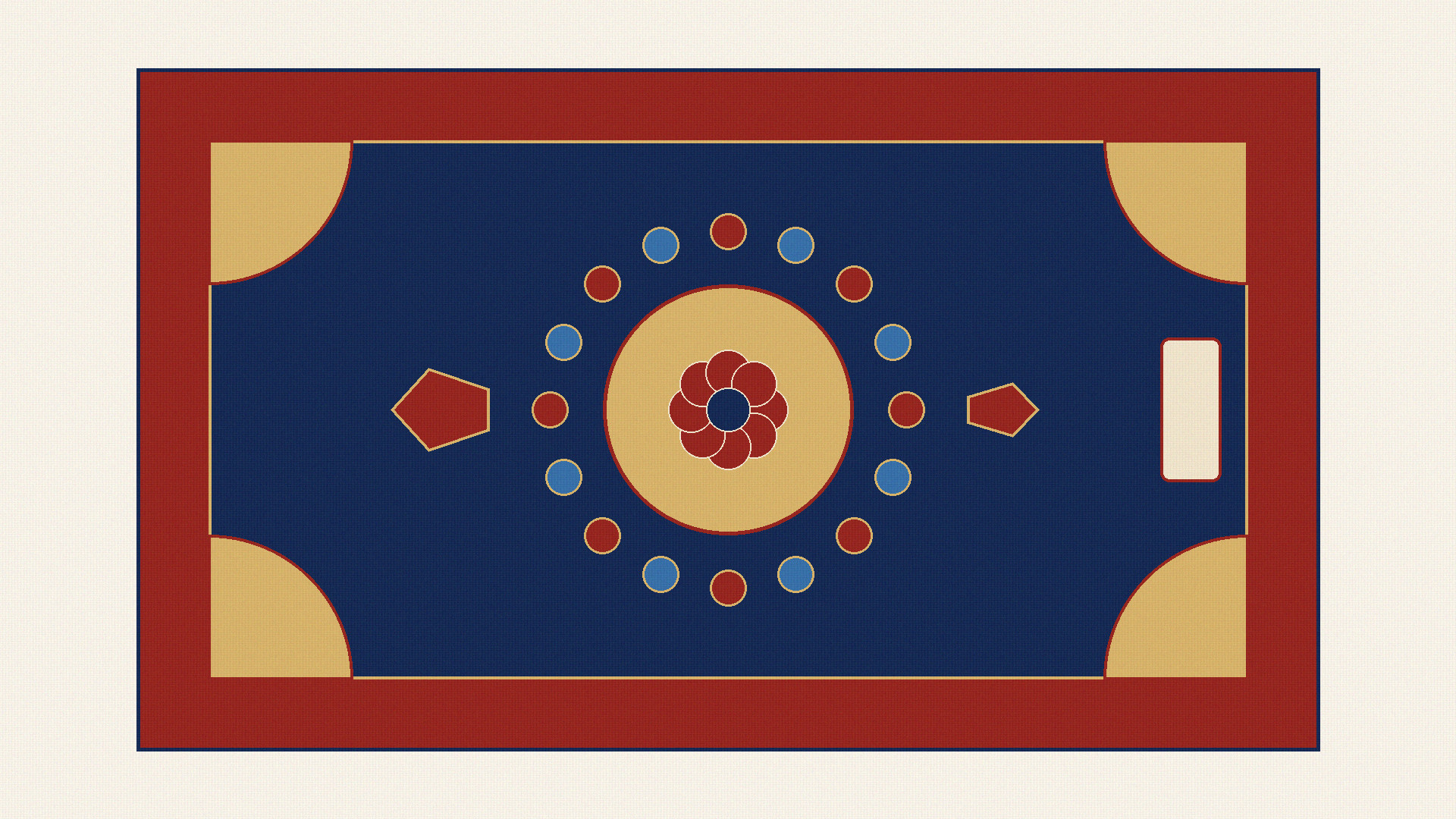
No single textile has shaped the global understanding of classical Persian carpet art more deeply than the Ardabil Carpet (قالی اردبیل) 12. Woven in Iran during the sixteenth-century reign of the Safavid Shah Tahmasp I (r. 1524–1576), it is the world’s oldest precisely dated Persian carpet and one of the largest and most harmonious surviving works of Islamic art 123. Its central golden medallion, floating oval pendants, hanging mosque lamps, and scrolling floral field remain a living blueprint for Iranian rug designers nearly five centuries later 124.
What It Is and Where It Is Today: The V&A and LACMA Pair
Although people often speak of "the Ardabil Carpet" in the singular, historical and technical scholarship confirms that two almost identical twin carpets were woven in the sixteenth century for the shrine complex of Shaykh Safi al-Din (d. 1334)—the spiritual ancestor of the Safavid dynasty—in the city of Ardabil in northwestern Iran 123. Today, both carpets survive in major public museums:
The London Carpet at the Victoria and Albert Museum (Museum No. 272-1893): Housed in a custom floor-level glass pavilion at the centre of the Jameel Gallery of Islamic Art at the Victoria and Albert Museum (V&A) in London 1. To protect its natural dyes from light degradation, the V&A illuminates the carpet for ten minutes on the hour and half-hour 1. Measuring approximately 10.51 by 5.34 metres, the London carpet is the more complete of the pair, preserving its full border system 13.
The Los Angeles Carpet at the Los Angeles County Museum of Art (Accession No. 53.50.2): Donated to the Los Angeles County Museum of Art (LACMA) in 1953 by J. Paul Getty, the second carpet preserves the central field, medallion, lamps, and inscription panel, though its outer borders were lost or removed during nineteenth-century restoration work 23.
Date and Inscription: A Dated Poetic Signature (946 AH / 1539–1540 CE)
Near one short end of the carpet field, just inside the main border, sits a rectangular woven cartouche containing four lines of Persian calligraphy 123. The first two lines quote a famous couplet (ghazal) by the fourteenth-century Persian poet Hafez of Shiraz, followed by a dedication and date 13:
"I have no refuge in the world other than thy threshold; / There is no protection for my head other than this doorway. / The work of the servant of the threshold, Maqsud of Kashan, in the year 946." 13
The Islamic lunar year 946 AH corresponds to 1539–1540 CE, making the Ardabil pair the earliest securely dated Persian carpets in existence 123. Scholars note that Maqsud Kashani ("Maqsud of Kashan") could not have knotted such a vast pair of carpets with his own hands alone; rather, he is generally understood to have been the court official, master supervisor, or project director who oversaw the commission on behalf of the Safavid royal court 13. Which specific royal workshop city wove the carpets—whether Tabriz, Kashan, or another Safavid centre—is not stated in the inscription and remains uncertain among historians 23.

The Design: Medallion, Lamps, Corner Spandrels, and Floral Field
The visual power of the Ardabil Carpet lies in how a monumental architectural geometry controls a delicate ocean of floral vines 134:
The Central Sunburst Medallion and Sixteen Pendants: At the centre of the deep indigo-blue field sits a golden-yellow sixteen-pointed lobed medallion (toranj) filled with fine arabesque tracery 13. Radiating outward around its perimeter like a collar are sixteen smaller pointed oval (ogival) medallions in alternating red, blue, and gold 13.
The Two Unequal Mosque Lamps: Suspended along the long central axis from two of the oval pendants—one above and one below the central medallion—are two woven images of enamelled glass mosque lamps 13. Remarkably, the two lamps are deliberately different in size and width 13. Art historians have proposed that this asymmetry was either an intentional optical perspective device—so the two lamps would look equal in size when viewed from one end of the shrine hall—or a philosophical expression of humility, though the designer’s exact reason is not recorded in Safavid texts and remains uncertain 13.
Four Corner Spandrels (Lachak): Each of the four corners of the field contains an exact quarter-section of the central medallion and its radiating oval pendants, locking the centre and corners into a unified Lachak-Toranj composition 134.
The Scrolling Field and Cartouche Border: Beneath the medallion layer, an intricate network of spiralling stems carries lotus palmettes, peonies, and split-leaf arabesques across the dark blue ground, framed by a wide main border of alternating oblong cartouches and lobed roundels 134.
How It Reached London and Los Angeles
British travellers recorded seeing the carpets inside the Ardabil shrine in 1843 13. Following nineteenth-century structural damage to the shrine buildings, the damaged carpets were sold in the late nineteenth century to fund repairs and were acquired by the British firm Ziegler and Co. and subsequently by the London carpet dealers Vincent Robinson and Co. 13.
Before the London carpet was exhibited in 1892, sections from the second carpet were used to repair damaged border areas of the first so that one complete carpet could be presented 13. Upon inspecting the carpet for the South Kensington Museum (now the V&A), the British designer William Morris praised its "singular perfection" and helped lead a public fundraising campaign that enabled the museum to purchase it for £2,000 in March 1893 1. The second, borderless carpet passed through private collectors—including Charles T. Yerkes, Joseph De Lamar, the Duveen brothers, and J. Paul Getty—before Getty donated it to LACMA in 1953 23.
Why the Ardabil Carpet Matters for Persian Rug Design
For nearly five hundred years, the Ardabil Carpet has served as the canonical reference for the Persian Lachak-Toranj (medallion-and-corner) layout 34. Its layered hierarchy—in which a bold medallion system floats effortlessly above an underlying field of continuous floral scrolls—taught generations of Iranian draughtsmen in Tabriz, Kashan, Isfahan, and Qom how to balance monumental architecture with delicate botanical detail 345.
Common Misconceptions
"There is only one Ardabil Carpet." Two matching carpets were woven in 1539–1540; one is in the V&A in London and the other is in LACMA in Los Angeles 123.
"Maqsud Kashani wove the entire carpet alone." A pair of carpets of this scale required a team of skilled weavers working for years from master cartoons; Maqsud of Kashan was almost certainly the court supervisor or patron in charge of the commission 13.
"The carpet is woven entirely of silk." As both the V&A and LACMA document, the foundation warps and wefts are silk, while the knotted pile itself is dyed wool, which holds deep, rich vegetable dye colours exceptionally well 123.
"The exact town where the loom stood is proven beyond doubt." Although the carpet was made for the shrine at Ardabil and signed by Maqsud of Kashan, whether the looms stood in Tabriz, Kashan, or another court centre remains uncertain 23.

A Short Practical Checklist: How to Spot an Ardabil-Inspired Design
- Look for the 16-Pointed Sunburst Medallion: Identify the golden-lobed central medallion surrounded by a ring of sixteen pointed oval pendants 13.
- Check for the Two Axial Mosque Lamps: Trace the long central axis above and below the medallion for the two hanging mosque lamps 13.
- Inspect the Quarter-Medallion Corners: Confirm that the four field corners repeat one-quarter of the central medallion and its oval pendants 13.
- Examine the Cartouche-and-Roundel Border: Look for alternating rectangular cartouches and circular lobed medallions in the main border 13.
Frequently Asked Questions (FAQ)
1. How old is the Ardabil Carpet?
The Ardabil Carpet is dated by its woven inscription to the Islamic year 946 AH, which corresponds to 1539–1540 CE during the reign of Safavid Shah Tahmasp I 123.
2. Where can I see the original Ardabil Carpet today?
The more complete carpet is displayed in the Jameel Gallery at the Victoria and Albert Museum (V&A) in London (Museum No. 272-1893), and its twin is in the Los Angeles County Museum of Art (LACMA) (Accession No. 53.50.2) 12.
3. Why are the two mosque lamps on the Ardabil Carpet different sizes?
One lamp is noticeably larger than the other along the vertical axis. Scholars suggest it may have been a perspective adjustment so both lamps appeared equal when viewed from one end of the shrine room, or a deliberate symbol of artistic humility, though the exact reason remains uncertain 13.
4. What does the inscription on the Ardabil Carpet say?
It features a famous couplet by the Persian poet Hafez—"I have no refuge in the world other than thy threshold; there is no protection for my head other than this doorway"—followed by the signature "The work of the servant of the threshold, Maqsud of Kashan, in the year 946" 13.
Sources
- Victoria and Albert Museum, London, "The Ardabil Carpet (Museum No. 272-1893), Iran, 1539–1540." https://www.vam.ac.uk/articles/the-ardabil-carpet
- Los Angeles County Museum of Art (LACMA), "Maqsud Kashani, Ardabil Carpet, dated 1539–40 (A.H. 946), Accession No. 53.50.2." https://collections.lacma.org/object/15378
- May H. Beattie, "ARDABĪL CARPET," Encyclopaedia Iranica, Vol. II, Fasc. 4, pp. 365–368 (1986; updated 2014). https://www.iranicaonline.org/articles/ardabil-carpet-persian-carpet-acquired-by-the-victoria-and-albert-museum-in-1893/
- Annette Ittig, "CARPETS iv. Knotted-pile carpets: Designs, motifs, and patterns," Encyclopaedia Iranica, Vol. IV, Fasc. 8, pp. 845–850 (1990; updated 2017). https://www.iranicaonline.org/articles/carpets-iv/
- Daniel Walker, "CARPETS ix. Safavid Period," Encyclopaedia Iranica, Vol. IV, Fasc. 8, pp. 866–875 (1990; updated 2017). https://www.iranicaonline.org/articles/carpets-ix/