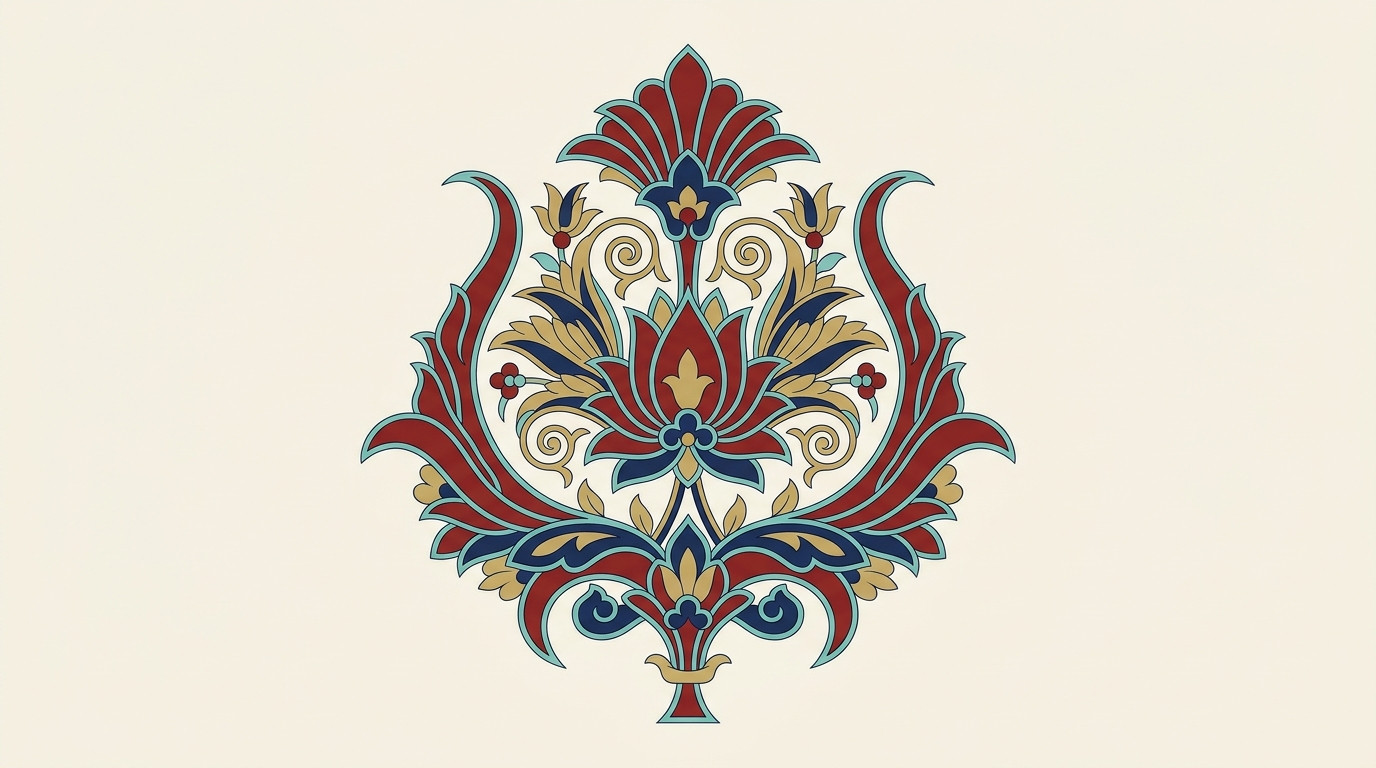
The Shah Abbasi motif (gol-e Shah Abbasi) is a large, symmetrical, fan-shaped flower known in textile studies as a palmette 14. It is linked across the rug by curling vines called eslimi and khatai 1. This article explains where the motif comes from, what it looks like, where it appears in a rug and how to recognise it.
History
Lotus-like flowers were used in Iranian art before the Safavids. The motif as rug buyers know it today is tied to the Safavid period (1501–1736) and above all to Shah Abbas I (r. 1588–1629) 2. After he made Isfahan his capital, court workshops produced carpets of very high quality, and the same floral language was used on tiles, books and textiles 25.
The sixteenth-century Ardabil carpet, now in the Victoria and Albert Museum, already combines a central medallion with scrolling palmettes 7. In the seventeenth century, silk carpets with metal thread, known as "Polonaise" carpets, show the fully developed style 3.
It is not recorded whether the name "Shah Abbasi" was used in the Shah's own lifetime or was given later in his honour. We treat this as uncertain 12.
What the motif looks like
A Shah Abbasi palmette is a flower seen from the side, not from above 14. It usually has:
- a curved base that grows from a vine;
- a teardrop-shaped core;
- layers of petals that open like a fan;
- two outer leaves that curve up and frame the flower.
It is an imaginary flower. It mixes features of the lotus, peony and pomegranate blossom rather than copying one plant 145.
How it differs from Herati and boteh
- Herati (mahi): a small repeating unit with a rosette inside a diamond and four curved leaves around it 14. Shah Abbasi palmettes are not locked in a diamond; they hang on free-flowing vines.
- Boteh: a teardrop with a bent tip that leans to one side 4. A Shah Abbasi palmette is symmetrical left and right.
Where it appears in a rug
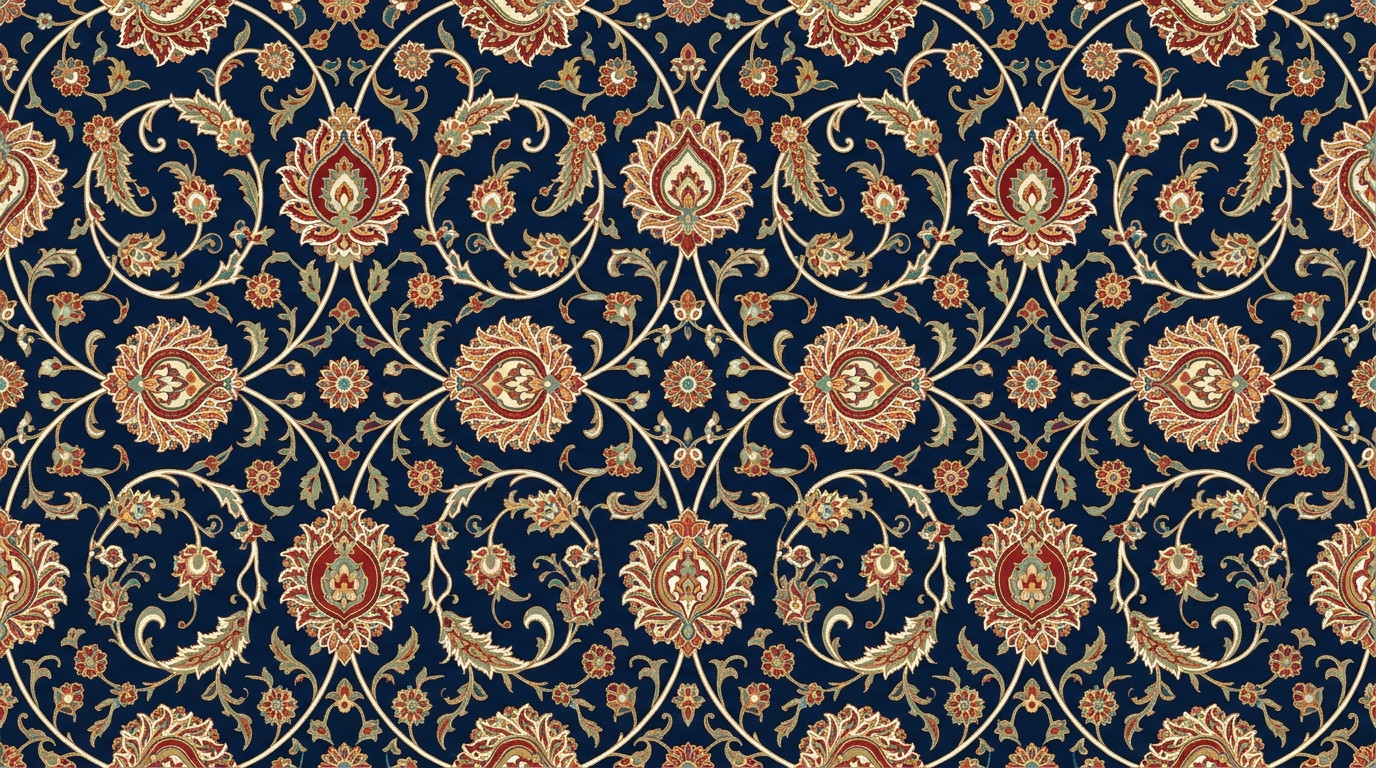
- Field: in an all-over (afshan) layout the palmettes and vines cover the whole field; in a medallion (lachak-toranj) layout they surround the medallion 1.
- Medallion: palmettes often form a ring inside the medallion or the pendants above and below it 17.
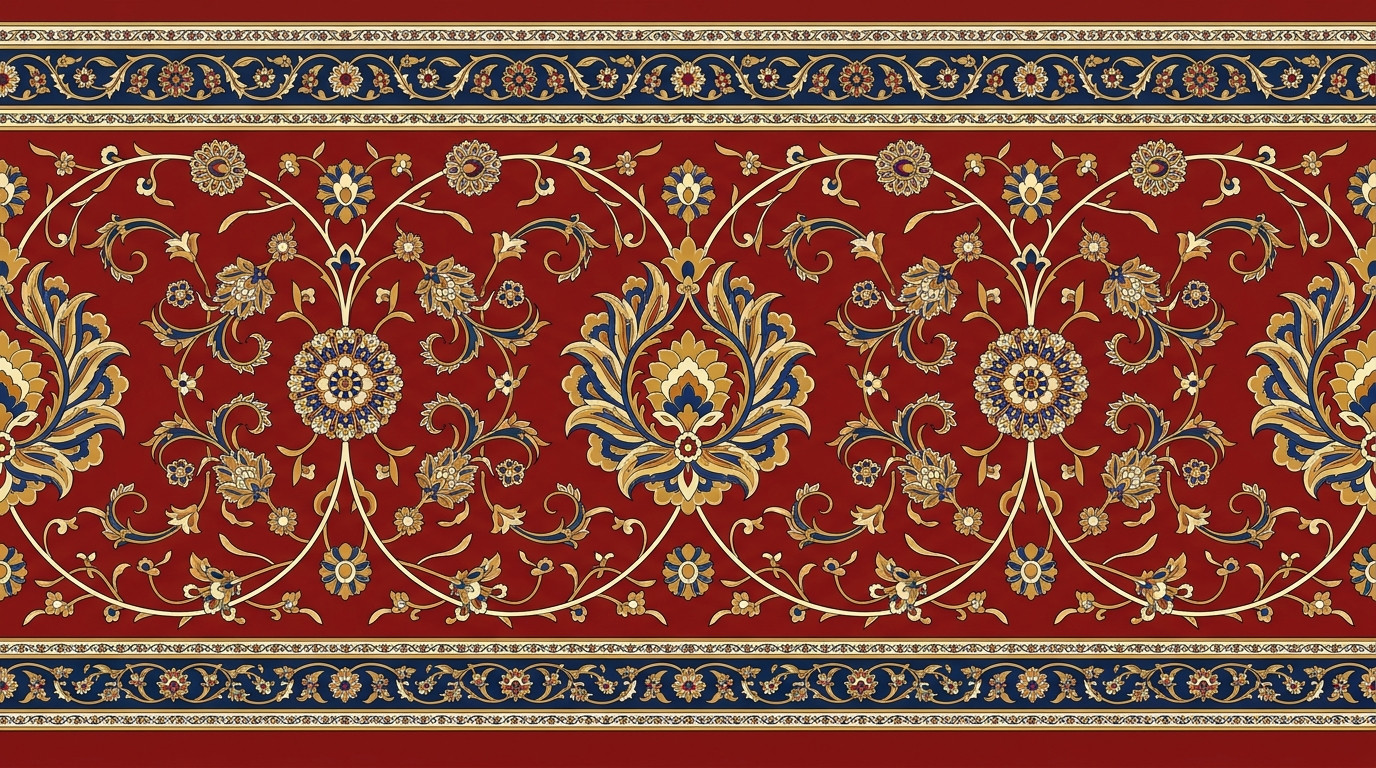
- Main border: large palmettes alternate with smaller flowers along a wavy vine 1.
Regional use
After the Safavid period the motif became shared vocabulary in Iran's city weaving centres. Encyclopaedia Iranica links Shah Abbasi patterns with workshops in Tabriz, Kerman, Nain and Isfahan 1; Kashan and Mashhad also used it widely 6. Each centre has its own drawing style and colours, but the palmette-and-vine structure stays the same.
Common misconceptions
- "A Shah Abbasi rug is from the seventeenth century." The name describes the design, not the age of the rug 24.
- "Shah Abbasi is one fixed layout." It is a motif family used in all-over fields, medallion designs and borders 1.
- "Each petal count has a secret meaning." We found no historical evidence for this 15.
- "Every floral Persian rug is Shah Abbasi." Other floral families, such as gol-e farang roses or mina-khani lattices, are different designs 1.
How to recognise it: a quick checklist
- Look for a fan-shaped flower seen from the side.
- Check that its left and right halves mirror each other.
- Follow the vine: the flower should grow from a curling stem.
- Make sure it is not inside a small repeating diamond (that would be Herati).
- Look at the main border for large palmettes on a wavy vine.
In modern machine-made rugs
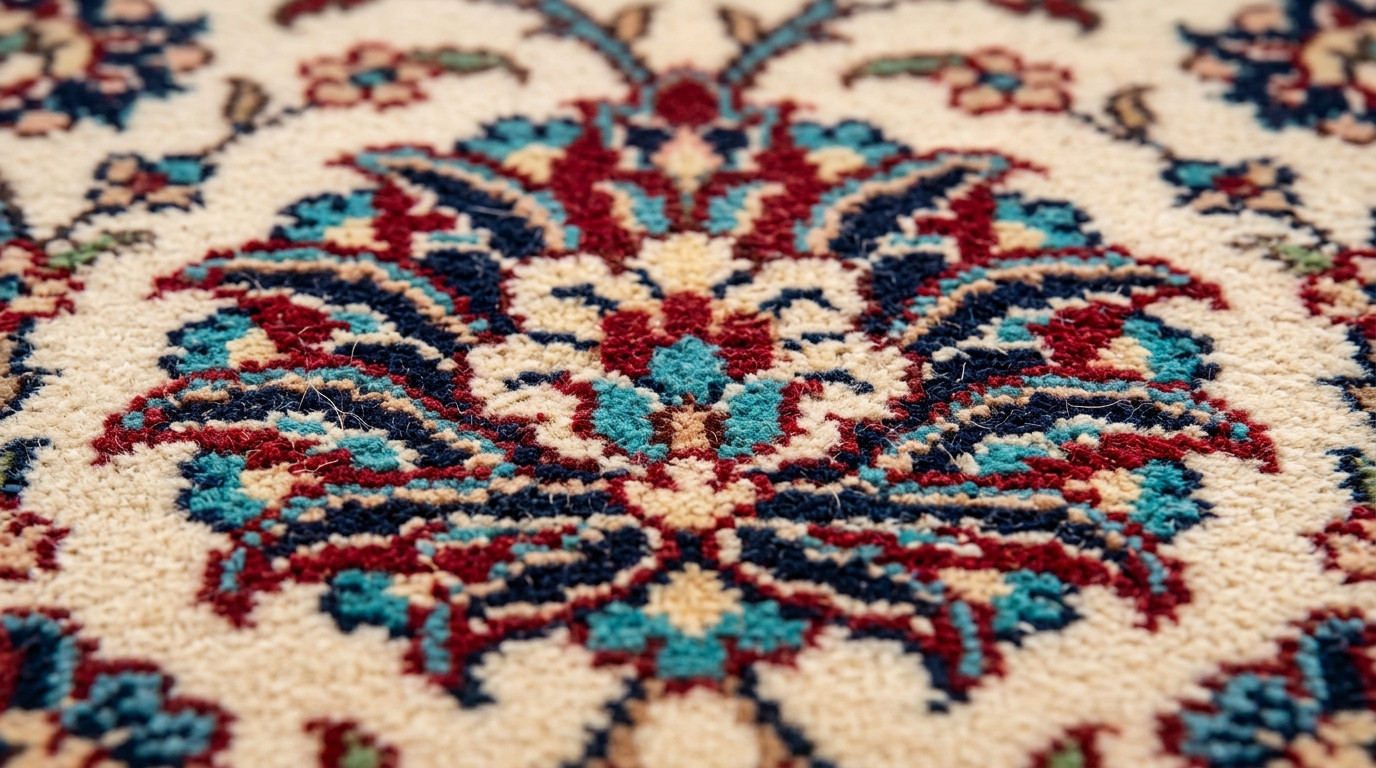
The Shah Abbasi motif is still a basic part of Iranian machine-made rug design. It appears in classical medallion layouts, in all-over afshan designs and in softer modern colour schemes. Because the motif depends on smooth curves, check that petal edges and vines look clean in the photo or sample.
Frequently asked questions
What does "Shah Abbasi" mean?
It means "related to Shah Abbas", after Shah Abbas I of the Safavid dynasty 2.
Is the motif a real flower?
No. It combines features of several flowers, mainly the lotus 14.
Can a rug have a Shah Abbasi border and a different field?
Yes. Field and border designs are chosen separately, for example a Herati field with a Shah Abbasi border 1.
Does "Shah Abbasi" tell you whether a rug is hand-knotted or machine-made?
No. It only names the design. Construction and fibre are separate details.
Sources
- Ittig, Annette. CARPETS iv. Knotted-pile carpets: designs, motifs and patterns. Encyclopaedia Iranica. https://www.iranicaonline.org/articles/carpets-iv/
- Walker, Daniel. CARPETS ix. Safavid period. Encyclopaedia Iranica. https://www.iranicaonline.org/articles/carpets-ix/
- The Metropolitan Museum of Art. 'Polonaise' Carpet, 50.190.4, Iran, 17th century. https://www.metmuseum.org/art/collection/search/451027
- Stone, Peter F. Oriental Rugs: An Illustrated Lexicon of Motifs, Materials, and Origins. Tuttle Publishing, 2013. https://search.worldcat.org/title/828416696
- Soucek, Priscilla P. DECORATION. Encyclopaedia Iranica. https://www.iranicaonline.org/articles/decoration/
- Edwards, A. Cecil. The Persian Carpet. London: Duckworth, 1953. https://archive.org/details/persiancarpetsur0000edwa
- Beattie, May H. ARDABĪL CARPET. Encyclopaedia Iranica. https://www.iranicaonline.org/articles/ardabil-carpet-persian-carpet-acquired-by-the-victoria-and-albert-museum-in-1893/